
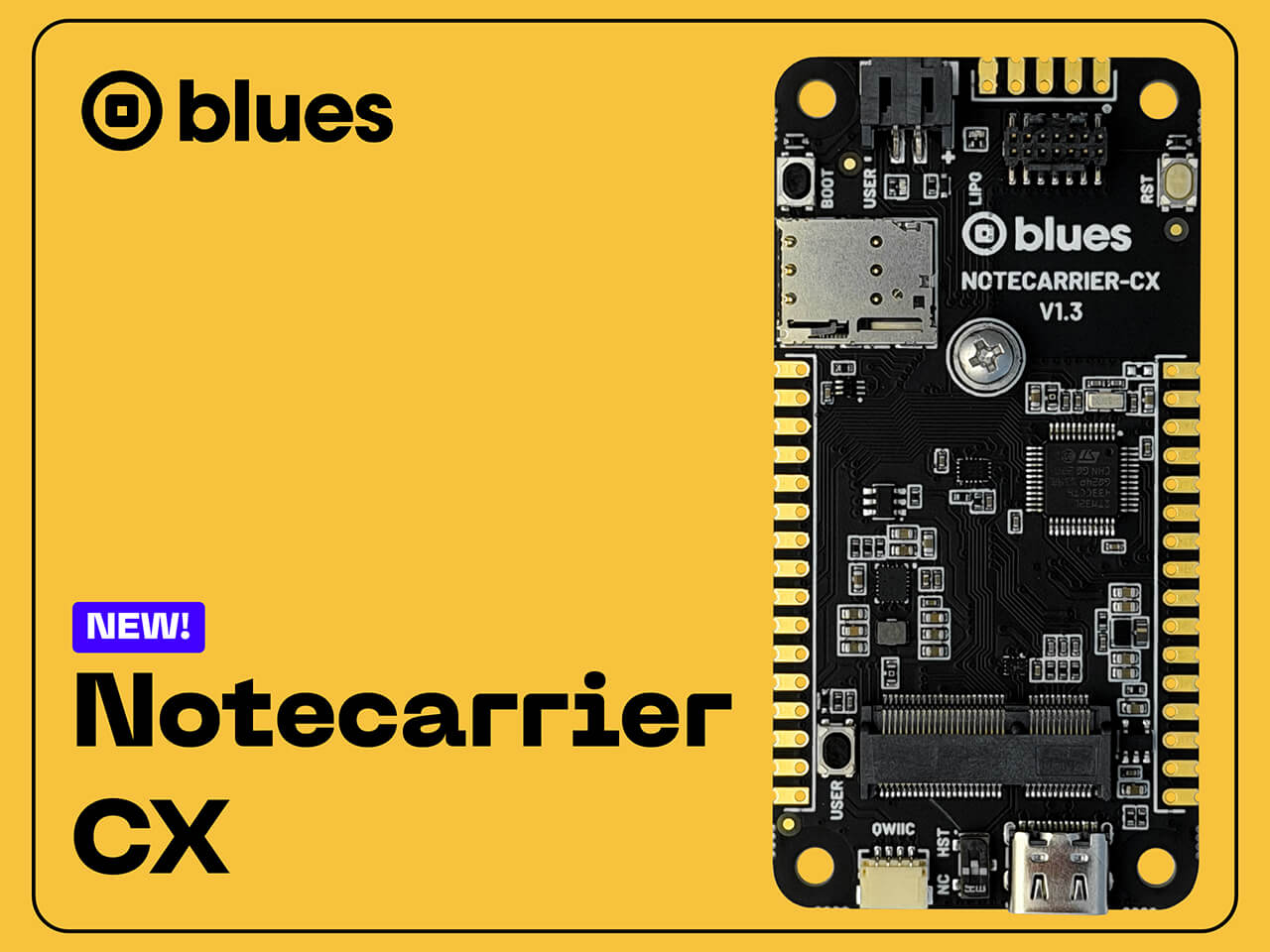

Today we're launching Notecarrier CX, a new member of the Blues Notecarrier family that's aimed squarely at embedded and IoT developers who desire reduced complexity while accelerating their prototype process.
tl;dr Notecarrier CX is essentially a Notecarrier X combined with a Blues Cygnet in one board, available for only $17.50.
You get the small, production-friendly Notecarrier X form factor, plus an onboard STM32 microcontroller as your host. One board instead of two, fewer wires, fewer decisions, and less setup before you're deploying real firmware.
| Front | Back |
|---|---|
 |  |
 note
noteCheck out the Notecarrier CX datasheet for complete details, and use the Blues Cygnet Quickstart to get started.
noteThis first version of Notecarrier CX is available as a BETA product. See the board errata section of the Notecarrier CX datasheet for details on known issues.
Key Notecarrier CX Features
Let's take a quick run through some key features that make Notecarrier CX a standout development board.
Onboard STM32L433 Host MCU
At the heart of Notecarrier CX is a user-addressable STM32L433 (yes, that's the same MCU used on Blues Cygnet), meaning you get:
- 80 MHz Cortex-M4
- 256 KB Flash
- 64 KB SRAM
- Ultra-low-power friendly design
To be clear, you can run your application directly on the board with no external host required. JTAG/SWD is available via an onboard debug jack, and BOOT/RST buttons are included for easy recovery and bootloader access.
Small Form Factor
The board measures 76mm x 38mm, with castellated edges that make it suitable for pick-and-place or solder-down use in production designs. It's compact enough to fit into real enclosures, not just on a lab bench.

USB-C for Power and Serial
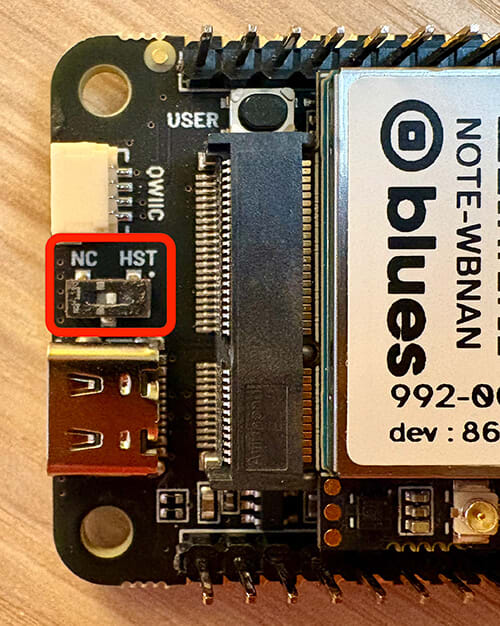
A single USB-C port can power the board and provides a USB serial interface. A DIP switch lets you choose whether USB connects to the Notecard or the onboard STM32 host:
Qwiic Port for Peripherals
There's a built-in Qwiic connector for I2C peripherals. Plug in sensors, displays, or other modules without touching a breadboard. It's an easy way to prototype real applications quickly.

You also get:
- A programmable
USER_BTN - Dual 16-pin headers exposing analog, digital, SPI, UART, and I2C
AUXdiagnostic headersATTNand power control signals from the Notecard- A JST port for connecting a LiPo battery
- An external SIM card slot for an optional Nano SIM
It's enough I/O to build serious prototypes without feeling constrained.
One Board, Fewer Compromises
Notecarrier CX is a great fit if you are looking to build a small form factor device with an integrated host MCU. It's especially useful for teams validating ideas, building proof-of-concepts, or shipping early pilot runs.
By combining the Notecarrier X and Blues Cygnet into a single, compact board, Notecarrier CX removes a lot of the early-stage friction we all experience! You still get the flexibility of the Notecard ecosystem, but with a tighter, more integrated starting point.
And yes, Notecarrier CX is available now! If you've been looking for a clean way to build Notecard-based systems, this might just be the board you've been waiting for.
Happy Hacking 💙