
Making the Business Case
As engineers, it's easy to focus on technical problems and ignore the business ones. That may be fine for personal projects, but it quickly becomes untenable when building smart connected products for businesses—especially for products that will be deployed at scale. In business, getting from idea to deployment often depends on convincing a stakeholder to approve your idea, allocate budget, or provide the resources you need to move forward at various points throughout the journey.
That challenge is compounded by the reality that many connected products never make it past the pilot stage. Business leaders have seen projects stall, costs spiral, or value remain unclear, which makes them understandably skeptical of new connectivity initiatives.
This guide will help you make a clear, credible internal case that a smart connected product built with Blues can deliver real business value and show you how to build and scale your products with confidence.
 note
noteKey Takeaways
- Anchor your case in measurable impact drivers that are proven across industries.
- Define the exact investment decision and approval criteria before building your financial model.
- Combine top-down market sizing with bottom-up operational forecasts to balance ambition with realism.
- Model both "Base" and "High" scenarios across volume, pricing, and costs, and show how margins evolve with scale.
- Pressure-test assumptions with Sales, Engineering, Operations, and Finance before formal review.
- Build internal champions across engineering, product, finance, and executive leadership.
In This Guide
This guide walks you through how to build and defend a credible investment case for a smart connected product:
- The Value of Smart Connected Products: How connectivity creates measurable operational and financial impact across industries.
- Crafting Your Board-Ready Business Case: How to size the opportunity, quantify impact drivers, define pricing, and model revenue and costs.
- Building Internal Champions: How to align engineering, product, finance, and executive sponsors behind the initiative.
- Business Case Readiness Checklist: A practical checklist to ensure your proposal is decision-ready.
The Value of Smart Connected Products
Numerous organizations worldwide use Blues to build smart connected products that improve operational efficiency, enhance customer experiences, and create new revenue streams. Here's how connectivity delivers business value across industries.
Transportation and Logistics
Smart connected products are reshaping transportation and logistics by saving money, improving safety and compliance, and increasing customer satisfaction—from connected batteries and intelligent container locks to remotely monitored tractor-trailer systems.
Loss prevention through always-on monitoring, asset location tracking, and geofencing detects, deters, and prevents losses due to theft, shrinkage, or spoilage. Cold chain compliance monitoring ensures cargo integrity from origin to destination.
Safety assurance improves driver safety and regulatory compliance through real-time alerts, condition monitoring, and automated documentation—reducing incident rates and keeping operations within regulatory boundaries.
Truck roll reduction eliminates unnecessary service visits by enabling remote diagnostics and management of fleet equipment, ensuring that when a technician does roll, they arrive prepared with the right parts and tools.
Learn more about smart connected transportation and logistics.
Commercial Equipment
Commercial equipment manufacturers are increasing customer satisfaction and driving new revenue streams with smart connected products—from self-diagnosing refrigeration units to remote-pump monitoring and intelligent brew control systems.
Downtime prevention keeps equipment running by remotely monitoring its condition and spotting emerging problems before they become failures—turning unplanned outages into scheduled maintenance windows.
Truck roll reduction means technicians no longer need to visit sites on a fixed schedule. Remote diagnostics identify exactly what's wrong (and what parts are needed), so visits happen only when necessary and are resolved on the first call.
Energy savings come from continuous monitoring that reveals patterns of waste, identifies failing components, and highlights opportunities to optimize equipment usage—lowering operating costs while extending equipment life.
noteReal-world example: Lift AI uses connected devices to monitor elevator performance, enabling predictive maintenance that prevents costly downtime and remote firmware updates that eliminate expensive on-site visits. Their connected architecture allows them to offer intelligent monitoring for roughly $500, compared to traditional sensor systems costing up to $10,000 per lift—demonstrating how lower-cost deployment enables wider market adoption.
Learn more about smart connected commercial equipment.
Commercial Buildings and Facilities
Smart connected products are redefining operations in commercial buildings and facilities—from connected HVAC and elevators to water systems and fire panels—by lowering operating costs, strengthening safety and security, preventing equipment failures, and enhancing tenant satisfaction.
Downtime prevention through continuous equipment monitoring ensures facilities operate smoothly, eliminating emergency service calls and keeping tenants satisfied. Data-driven maintenance prevents equipment failures and maximizes system availability.
Safety assurance enables reliable, always-on monitoring that helps facilities meet regulatory requirements and reduce incident rates—driving concrete value through improved compliance, reduced liability, and fewer operational disruptions.
Energy savings from monitoring building systems reveal where waste is occurring and enable optimization that lowers utility costs—often the single largest controllable expense for commercial facilities.
noteReal-world example: Impact Services Group, a nationwide HVAC services provider, uses connected monitoring to convert $800 emergency calls into scheduled repairs during business hours. Real-time diagnostic data allows technicians to arrive prepared with the right context, eliminating costly troubleshooting and weekend outages. One $600 device delivers clear ROI even for cost-sensitive commercial sites.
Learn more about smart connected buildings and facilities.
The examples above show how connected products create operational and financial impact across industries. The next step is translating that impact into a structured investment case. To secure approval and budget, you must move from describing value to quantifying it.
Crafting Your Board-Ready Business Case
Making a successful business case requires more than describing benefits. You must show how value is created, what it costs to build and operate, how the economics scale, and how resilient the model is under different scenarios.
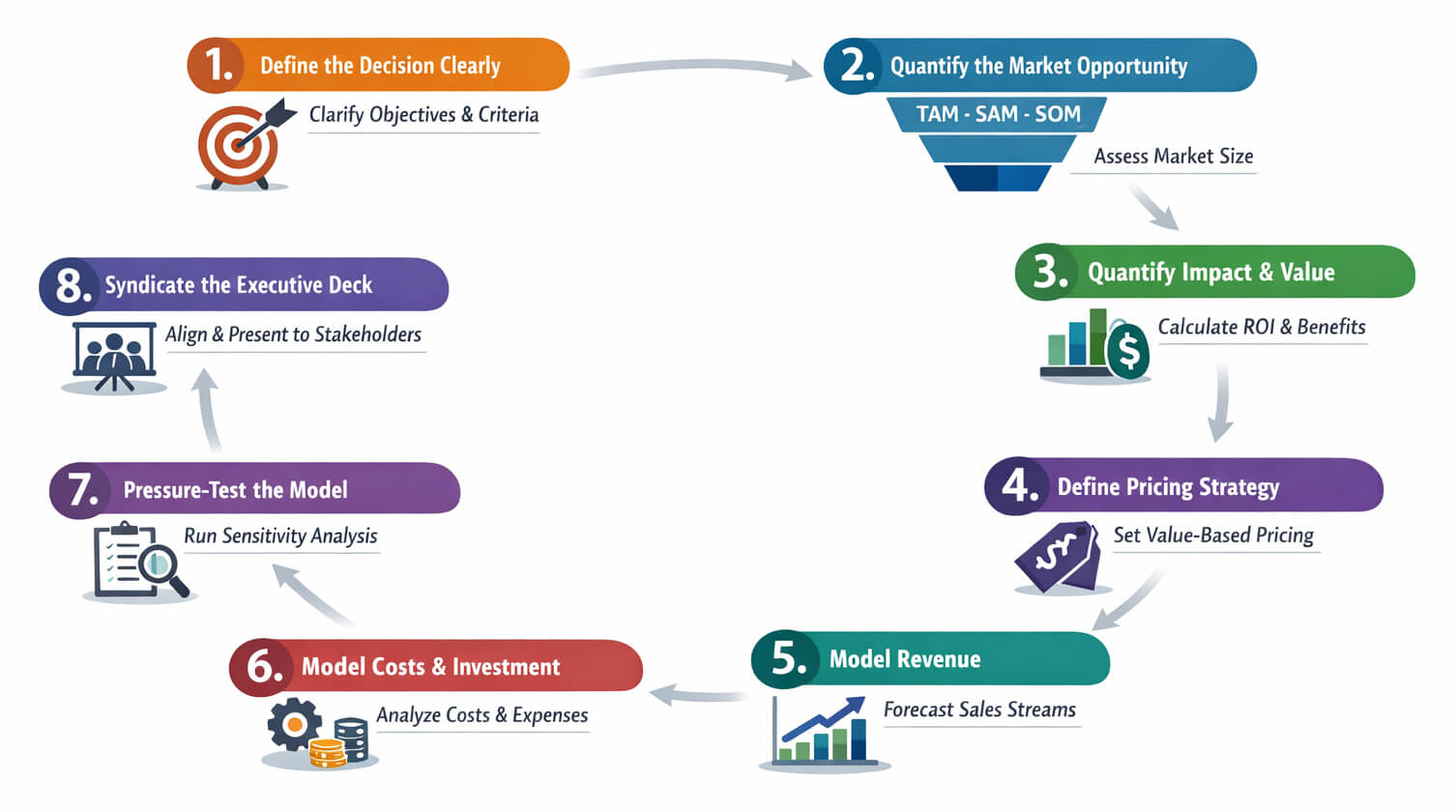
Throughout this process, model at least two scenarios: a conservative "base" case and a high-performance case reflecting strong execution. Executives rarely evaluate a single projection. They evaluate the range of outcomes and the assumptions that drive them. Apply this scenario discipline across volume, pricing, costs, and operating expenses. Executives evaluate ranges, not single-point forecasts.
Step 1: Define the Decision Clearly
Start by clarifying the exact decision being requested. What investment is required? What approval is needed? Who makes the decision?
Identify the decision-makers, their evaluation criteria (payback period, ROI, IRR, strategic alignment, competitive risk), and the success thresholds they will apply (e.g., break-even within 24 months).
A strong business case answers the decision criteria directly. Without that clarity, even accurate models can miss the mark.
Step 2: Quantify the Market Opportunity
Market sizing is strongest when it combines both top-down and bottom-up approaches.
Top-Down: TAM, SAM, SOM
A top-down approach estimates:
- TAM (Total Addressable Market) — all potential users
- SAM (Serviceable Available Market) — those you can realistically reach
- SOM (Serviceable Obtainable Market) — what you can capture in 3–5 years
This approach is helpful when entering new categories or when framing strategic upside. It forces you to articulate constraints such as geography, sales capacity, integration requirements, or regulatory barriers.
However, TAM estimates can be unreliable when industry data is limited or when markets are emerging.
Bottom-Up: Operational Reality
A bottom-up approach starts with what you already know. For example, if you are launching a connectivity module for an existing product, review historical unit sales, estimate attach rates on new sales, estimate retrofit penetration on the installed base, and factor in churn, sales capacity, and channel readiness.
This approach is often more defensible because it builds from actual performance.
Why Combine Both?
Top-down defines ambition, while bottom-up defines realism. If they diverge significantly, revisit assumptions. Once market size is estimated, build a quarterly volume forecast under both Base and High scenarios, factoring in adoption ramp timing, sales team capacity, pricing sensitivity, competitive response, and production constraints.
Don't expect hockey-stick growth. Most connected products ramp up gradually.
Step 3: Quantify Impact Drivers and Customer Value
Frame core pain points as impact drivers, or measurable financial levers such as downtime reduction, service visit reduction, energy optimization, safety improvements, and loss prevention.
For each driver, research operational benchmarks, use customer interviews where possible, and quantify savings or incremental revenue. Then calculate:
- Customer Value = Cost savings + Revenue gains
- Customer ROI = Customer Value / Your Price
For most B2B connected products, a 3-5x ROI supports adoption.
Importantly, treat early pilots as validation tools. Use pilot data to refine assumptions and update the business case with real-world evidence. A model backed by field data carries significantly more weight.
Step 4: Define Pricing Strategy
Pricing should be anchored in value creation, not just cost recovery.
As a starting point, many connected products capture 15-30% of measurable value on average while preserving strong customer ROI.
Subscription pricing is an iterative experiment—it is easier to start slightly higher and adjust downward than to raise pricing after customers anchor low. Preserve margin flexibility for volume discounts and enterprise negotiations, and ensure pricing supports your broader growth strategy.
Conduct structured competitive benchmarking to inform the strategy. Consider how alternatives are priced, whether hardware and services are bundled, how aggressively competitors are discounting, and what positioning their pricing signals.
If entering multiple markets simultaneously, consider whether regional purchasing power, distribution models, regulatory costs, or support infrastructure justify differentiated pricing.
Step 5: Model Revenue
Separate hardware revenue (one-time) from subscription revenue (recurring). Project quarterly unit sales under both scenarios, then model the active installed base, accounting for new additions and churn.
Recurring revenue compounds over time. Make this growth dynamic explicit. In many connected models, subscription expansion becomes the primary driver of long-term profitability.
Step 6: Model Costs and Total Investment
Distinguish clearly between per-unit costs and operating expenses.
Per-Unit Costs (COGS + Variable Costs)
Include:
- Bill of materials
- Manufacturing
- Connectivity
- Cloud usage
- Platform routing
Model cost per device at different volume tiers. Many cost categories improve with scale, including:
- Component pricing
- Manufacturing efficiency
- Cloud cost per device
- Data routing or platform costs
Show how gross margin evolves as volume increases.
Operating Expenses (OpEx)
Project quarterly OpEx separately. Include:
- Engineering / ongoing R&D headcount and costs
- Sales and marketing spend
- Customer support
- Legal costs
- Certification and legal/compliance expenses (if required)
- General and administrative overhead
Avoid flat headcount assumptions. OpEx should scale logically with volume growth. Then calculate gross margin, break-even timing, and cumulative profitability.
Executives will scrutinize margin profile and cash requirements as much as revenue growth.
Step 7: Pressure-Test the Model
A credible model must withstand scrutiny. Pressure-test assumptions with the right stakeholders. Sales can validate adoption and attach rate assumptions, Engineering can confirm BOM and certification costs, Operations can confirm production ramp feasibility, and Finance can validate margin logic and cash projections.
Run sensitivity scenarios where helpful, such as lower adoption, reduced pricing and its impact on adoption, or higher hardware or cloud costs.
If the model only works under optimistic assumptions, it will not survive executive review. A resilient model builds confidence.
Step 8: Prepare and Syndicate the Executive-Level Deck
An investment case should be socialized before formal approval discussions. Identify the internal champions who must support the initiative, including engineering leadership, product management, finance, and an executive sponsor. Each group evaluates the proposal through a different lens, and the case should be tailored accordingly.
Finance stakeholders will focus on break-even timing, margin profile, and cash requirements. Executive sponsors will evaluate strategic alignment, competitive positioning, and long-term growth potential. Product leadership will assess differentiation and roadmap fit, while engineering leadership will examine technical feasibility and execution risk.
Rather than presenting the model for the first time in a formal approval setting, schedule working sessions with key stakeholders to walk through assumptions, projections, and risks. Incorporate their feedback and address objections early. By the time the proposal reaches final review, the core influencers should already understand and support the underlying logic.
A strong business case is not simply a financial model. It is a coordinated internal effort supported by defensible assumptions, validated impact drivers, and aligned champions across the organization.
Building Internal Champions
A successful business case requires more than solid financial modeling—you need the right people advocating for your project. Connected product initiatives touch engineering, product, finance, and executive leadership, and each group needs to see the value through their own lens. Before diving into specific arguments, think about the champions you'll need and why.
First, identify who your internal customer is—the person or team whose problem your connected product solves. Then identify who controls the budget and who has the authority to greenlight the initiative. These may be different people. You'll need a champion at each level: someone technical who believes the product can be built, someone in product who believes customers want it, someone in finance who believes the numbers work, and someone in leadership who believes it aligns with company strategy. Without champions at multiple levels, connected product initiatives tend to stall during budget cycles or lose priority to competing projects.
Here are some arguments we've found persuasive when talking to each type of stakeholder.
Engineering Leadership
When speaking with engineering leadership, lead with a quick summary of the business impact you are trying to have, then focus on technical feasibility, reduced development risk, and speed to market. Emphasize how pre-certified modules like Blues Notecard reduce complexity. Highlight the ability to iterate quickly during prototyping, and show how remote firmware updates reduce post-deployment risk.
Product Leadership
Product managers and product leaders care about customer outcomes, market differentiation, and roadmap fit. Show how connectivity transforms a one-time product sale into an ongoing intelligent service that generates new revenue and deepens customer relationships. Highlight the competitive landscape—if your competitors are already offering connected products, you risk losing ground. If they aren't, this is a differentiation opportunity. Frame the initiative around the values that matter to your customers.
Finance and Operations
For finance and operations stakeholders, focus on clear ROI, predictable costs, and operational efficiency. Lead with the quantified savings from the impact drivers in your business case, emphasize predictable pricing with no surprise cellular bills, and show how connected products reduce operational overhead. Be clear about where you're working from known facts, and where you're making assumptions, and what backs up the assumptions you're making.
Executive Sponsors
Executive sponsors care first and foremost about business impact: will this create real, measurable value? Beyond that, they focus on strategic alignment, competitive differentiation, and market opportunity. Connect your initiative to broader company goals like digital transformation or service revenue growth. Highlight competitive pressure as your competitors may already be offering connected products and frame this as a platform for future innovation, not just a single product.
noteThe most successful connected product initiatives have champions at multiple levels of the organization who can advocate for the project through budget cycles and competing priorities.
With a clear value proposition established, the next step is choosing a platform that helps you execute—quickly, securely, and at scale. So when presenting your investment case, stakeholders will inevitably ask: why this platform? The real question behind that is risk. How does this choice reduce execution risk, shorten time to validation, and prevent cost overruns? Learn more in Economics of Blues at Scale
Business Case Readiness Checklist
Before presenting your smart connected product proposal, make sure you can clearly address the following:
Value and Market
- Can you clearly articulate the problem being solved and who feels it most acutely?
- Have you quantified at least one primary impact driver (e.g., downtime, truck rolls, energy, safety, loss prevention)?
- Have you estimated TAM, SAM, and SOM, including explicit market constraints and/or have you built a bottom-up volume forecast grounded in operational reality?
Customer Economics
- Have you calculated total customer value created using defensible assumptions or benchmarks?
- Does your proposed pricing deliver a compelling customer ROI story (e.g., 3-5x target)?
- Do you have a plan to validate key assumptions through customer pilots?
- Have you conducted competitive benchmarking on pricing, bundling, and market positioning?
Financial Model
- Have you modeled both Base and High scenarios across volume, pricing, and costs?
- Have you separated per-unit costs from operating expenses?
- Have you modeled how margins evolve with economies of scale?
- Have you defined break-even timing, gross margin, and cumulative profitability?
- (If applicable) Have you conducted sensitivity analysis on adoption, pricing, and cost assumptions?
Organizational Alignment
- Have you identified the decision-makers, their evaluation criteria, and their success thresholds (e.g., payback period, break-even timing)?
- Have you identified the key internal champions required for approval?
- Have you pressure-tested assumptions with Sales, Engineering, Operations, and Finance?
- Have you socialized the proposal with executive stakeholders before formal approval?
Strategic Rationale
- Can you clearly explain why this initiative matters now (competitive, operational, or strategic drivers)?
- Can you defend your platform and execution strategy in terms of risk, speed, and cost predictability?
Resources and Next Steps
Whether you're trying to prevent downtime, reduce truck rolls, save energy, assure safety, prevent losses, or unlock entirely new revenue streams, you now have a foundation to confidently advocate for your connected product initiative. Use the business value framework, stakeholder strategies, and objection responses in this guide to move the conversation forward.
Additional Resources
- Blues Starter Kits — Get hands-on with hardware in days
- Pricing Details — Plan your costs from prototype to production
- Customer Stories — See how other teams have succeeded
Getting Help
If you have additional questions about making a business case for your connected product:
- Post questions on the Blues Community Forum
- Contact Blues sales for enterprise-level support