Notehub API
This API reference contains an overview of all requests relevant to interacting with Notehub. Each section details request parameters, response members, example cURL requests, and JSON responses.
- New to the Notehub API?
- Check out Using the Notehub API, our tutorial which walks you through running your first few requests.
- Want to access the Notehub API in JavaScript or Python apps?
- Try our Notehub JS and Notehub Py libraries, available on npm and PyPI, respectively.
- Are you a Postman user?
- We provide a Postman Collection for easy access to all Notehub API requests.
On this page:
Authentication
All Notehub API requests require a Personal Access Token (PAT), a token tied to your Notehub user account that you create and manage from the Notehub user interface.
Creating a Personal Access Token
Complete the following steps to create a new personal access token.
-
Navigate to Notehub and sign into your account.
-
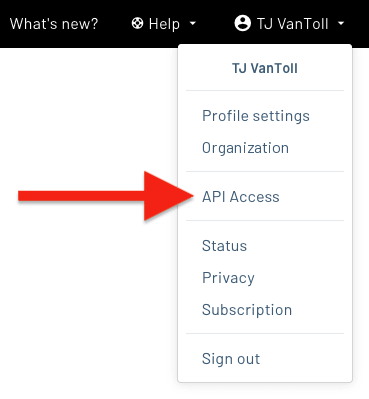
From the user menu in the top-right corner, select the API Access option.
-
On the next screen, click the Create New Token button.
-
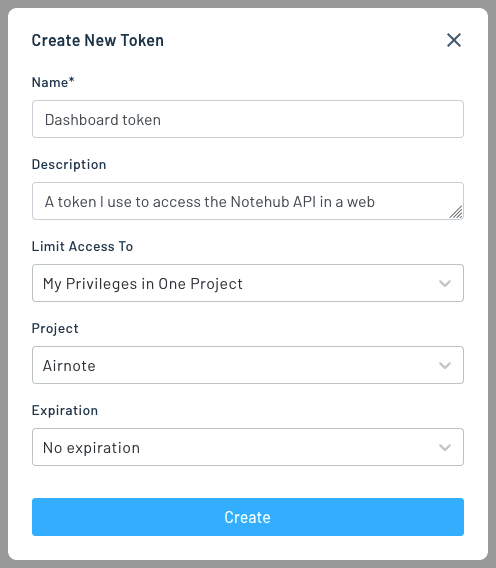
In the resulting dialog, give your token a Name and an optional Description.
-
Use the Limit Access To dropdown to choose what the token can access (see Token Access below). If you choose a one-project option, also select the token's Project.
-
Choose an Expiration, and then click Create.
-
In the next dialog, use the Copy button to copy the token to your clipboard and store it somewhere safe.

warning Treat personal access tokens like passwords. Anyone with your token can do anything the token's access allows.
Token Access
The Limit Access To option controls what a token can do. You can't change it after you create the token.
- My Privileges in All Projects and Organizations: Everything your Notehub account can do. This is the default.
- My Privileges in All Projects: Everything you can do in your projects, but no access to your organizations.
- My Privileges in One Project: Everything you can do in a single project.
- Viewer Privileges in All Projects: Read-only access to your projects.
- Viewer Privileges in One Project: Read-only access to a single project.
In general, we recommend choosing the narrowest access option necessary. A dashboard that only reads one project's events, for example, needs only Viewer Privileges in One Project.
Using a Personal Access Token
After you create a personal access token, you can use that token to authorize
subsequent Notehub API requests. All Notehub API requests accept a
Authorization: Bearer <your_token> header for authorization.
Suspending and Deleting Personal Access Tokens
Personal access tokens expire according to the interval you selected when you created the token. The API Access page lists each of your tokens, along with its access, expiration date, and when it was last used.

If you wish to deactivate your token before its expiration date, you can use the action menu on the right-hand side of the table (see image below). A suspended token cannot be used to authorize Notehub API requests until you resume it, and a deleted token is removed from Notehub entirely.

The API Access page also lists apps you've signed in to with your Notehub account, such as the Notehub CLI or an AI agent using the Notehub MCP. These appear with a Type of Sign-in, and you can suspend or delete them the same way.
Usage Limits
You may perform 7 Notehub API requests per minute (up to 10,200/day), per billing account, free of charge.
If you exceed this threshold you may receive a 429 HTTP response code from
subsequent Notehub API calls, indicating you've exceeded the free threshold. For
high-volume or "bulk" operations, you may be able to utilize a
Batch Job instead.
Higher API usage limits are available through Notehub Enterprise plans. See Blues pricing or contact Blues sales for more information.
Using Array Arguments
Many Notehub API request arguments accept arrays as values. For example,
the Get Project Devices
request offers a tag argument that allows you to filter devices by
their associated tags.
When array arguments are accepted by GET requests, the Notehub API expects them
to be passed in the following format:
/endpoint-name?argumentName=value1&argumentName=value2For example, to use the Get Project Devices endpoint to get devices with a single tag, you could use the following request:
/projects/{projectOrProductUID}/devices?tag=tag1And to get devices with multiple tags, you could use the following request:
/projects/{projectOrProductUID}/devices?tag=tag1&tag=tag2If you're using the Notehub API in Postman, the screenshot below shows how you can provide array arguments.

Request Listing
Billing Account API
Deprecated. Use the Organization API instead to retrieve data related to Notehub organizations.
Device API
GET, POST, and DELETE data related to the devices in a Notehub project.
Event API
Retrieve the event data your devices have synced to Notehub.
Jobs API
Create and manage the batch jobs that operate across a Notehub project.
Monitor API
Manage the alerts that notify you when your project needs attention.
Organization API
Retrieve data related to Notehub organizations, including their projects and billing.
Project API
Retrieve and manage project-level data, including fleets and environment variables.
Route API
GET, POST, PUT, and DELETE the routes that forward Notehub events to your cloud.
Usage API
Retrieve usage data and metrics for API requests, data, events, route logs, and sessions.