
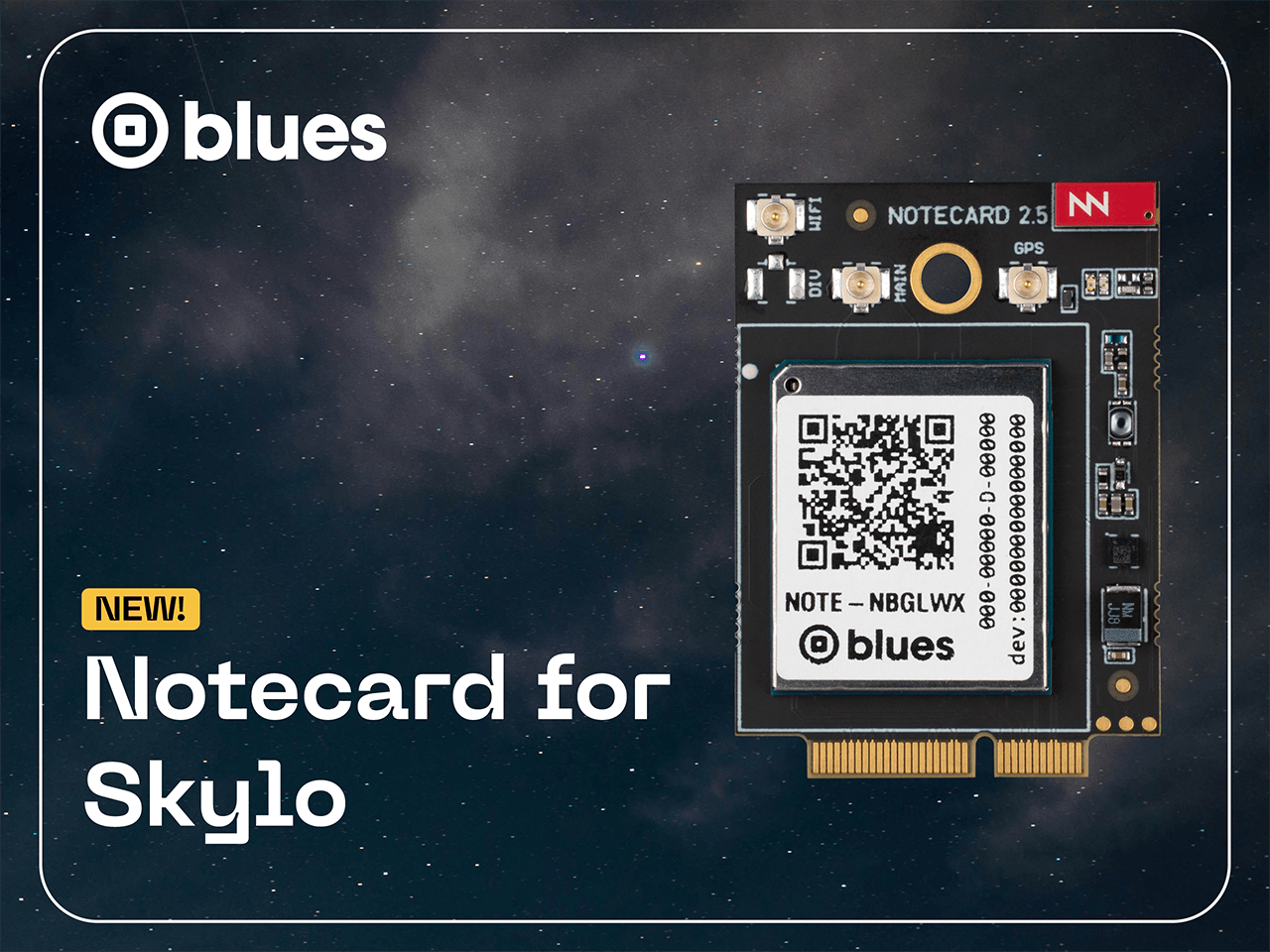

Today we're pleased to announce the availability of Notecard for Skylo - a first for Blues and the wireless connectivity industry. With Cellular, WiFi, and Satellite on a single Notecard design, it's the only module to combine all of these with bundled data and no monthly fees.
tl;dr Notecard for Skylo provides narrowband cellular (LTE-M/NB-IoT/GPRS) connectivity, 2.4 GHz WiFi, and satellite (NTN) in a single Notecard design. It ships with 500MB of bundled cellular data and 10KB of bundled satellite data, with no subscriptions or recurring fees.
If you've ever deployed connected devices in environments where cellular coverage is spotty or nonexistent, you already know the problem Blues is trying to solve. Drop this device into your product design and immediately expand your network coverage!
| Front | Back |
|---|---|
 |  |
 note
noteCheck out the Notecard for Skylo datasheet for complete technical details and visit the Blues store to get yours today.
Why Satellite Matters for the IoT
Cellular networks cover a lot of the planet, but not all of it. Agricultural fields, remote pipelines, offshore assets, wilderness conservation sites - these are exactly the kinds of places where IoT devices need to report data, and exactly the places where cellular towers don't always reach.
Satellite connectivity fills those gaps. Until now, adding satellite to your product meant adding a 2nd module (e.g. Blues Starnote). And if you didn't use Starnote, you also had to worry about adding a 2nd data plan and a 2nd set of integration headaches. Notecard for Skylo changes that by putting all three network options on a single board, with a single unified developer API.
noteStarnote for Skylo isn't going anywhere! This product will continue to be useful in product designs that require satellite fallback from wideband (LTE Cat-1) or midband (LTE Cat-1 bis) cellular networks.
How Notecard for Skylo Works
Notecard for Skylo uses the same JSON-based API you already know. Your firmware doesn't need to know (or care) which network is active as Notecard handles network selection and failover automatically. With the card.transport API, you determine which networks to use, and in which order.
For example, with this command:
{
  "req": "card.transport",
  "method": "cell-ntn"
}
You tell Notecard for Skylo that when cellular is available, try to sync data over LTE-M, NB-IoT, or GPRS. When it's not, Notecard should fall back to Skylo's satellite network for uplink and downlink.
Onboard WiFi provides an additional connectivity option (e.g.
"method": "wifi-cell-ntn"), plus the use of
WiFi Triangulation
for when using Notecard's GPS isn't ideal.
noteRead about how to get started with Notecard for Skylo and consult additional Satellite Best Practices.
Key Notecard for Skylo Highlights
Here's a quick look at what makes Notecard for Skylo stand out:
Three Networks, One Module
Notecard for Skylo combines LTE-M, NB-IoT, GPRS cellular, 2.4 GHz WiFi, and Skylo satellite (NTN) in the same Notecard form factor you're already familiar with. It's sized to match the dimensions of Notecard Cell+WiFi, so it drops into existing Notecarrier designs without modification.
Bundled Data, No Monthly Fees
Every Notecard for Skylo ships with 500MB of bundled cellular data and 10KB of bundled satellite uplink/downlink data in partnership with Skylo. There are no subscriptions, monthly minimums, or recurring provider fees. You can add additional satellite data as needed at a cost of $0.75/KB.
Global Coverage
Cellular coverage spans 140+ countries, while satellite coverage is provided by Skylo's network. Between the two, Notecard for Skylo can reach devices in locations that were previously impractical or impossible to connect.
Same Developer Experience
If you've used a Notecard before, you already know how to use Notecard for
Skylo. The same note.add, hub.sync, and card.* APIs work exactly as they
always have. Data flows to Blues Notehub and routes to
your cloud of choice (e.g. AWS, Azure, GCP, or your own HTTP- or MQTT-based
pipeline).
Low Power, MCU-Agnostic
Like every Notecard, Notecard for Skylo is designed for battery-powered deployments with minimal idle current draw. It supports any MCU or single-board computer as your host processor, communicating over I2C, Serial, or USB.
Proven Viability
Blues has been in the satellite business now for multiple years. We're continually improving our hardware and firmware to support satellite connectivity as a first class citizen in our ecosystem.
In fact, I've had a Notecard for Skylo running in my backyard for nearly three months now (powered by nothing more than a LiPo battery and a small solar panel!).

Technical Specs at a Glance
| Spec | Detail |
|---|---|
| SKU | NOTE-NBGLWX |
| Modem | Quectel BG95-S5 |
| Cellular Networks | LTE-M, NB-IoT, GPRS |
| Satellite | Skylo (NTN) |
| WiFi | Silicon Labs WFM200S (2.4 GHz 802.11b/g/n) |
| Bundled Cellular Data | 500MB |
| Bundled Satellite Data | 10KB |
| Connectors | Two u.FL (MAIN for cellular/satellite antenna, GPS for GNSS) |
| Interface | I2C, UART, USB |
Get Started Today
Notecard for Skylo is available now in the Blues store. If you're already building with Blues, it's a drop-in addition to your toolkit. If you're new to the platform, there's never been a better time to start integrating multiple radio options into your smart connected product!
We can't wait to see what you build with Notecard for Skylo. 💙