What is Satellite IoT? A Guide for Embedded Developers

Key Takeaways
- Satellite IoT connects devices in remote regions beyond the reach of terrestrial cellular, WiFi, or LoRaWAN — oceans, mountains, deserts, rural expanses.
- NTN (Non-Terrestrial Networks) are standardized under 3GPP Release 17, extending cellular NB-IoT protocols to operate over satellite links.
- Blues Starnote pairs with any Notecard to add seamless cellular-first, satellite-fallback connectivity — with no separate satellite API to learn.
- Store-and-forward by default — Notecard queues data during coverage gaps and syncs when any network (cellular or satellite) becomes available.
Introduction
Satellite IoT (Internet of Things) refers to the use of satellite communication networks to connect devices that operate beyond the reach of terrestrial cellular, WiFi, or LoRaWAN infrastructure. These devices transmit and receive data through satellites orbiting the Earth, enabling connectivity in remote areas such as oceans, mountains, deserts, and rural expanses. This capability is crucial for industries such as agriculture, transportation, energy, environmental monitoring, and defense, where continuous and reliable connectivity can be mission-critical.
At its core, Satellite IoT bridges the gap between ground-based sensors and cloud-based systems, enabling real-time decision-making, predictive maintenance, and long-range tracking. Whether you're monitoring soil moisture in a remote vineyard, tracking shipping containers crossing the Pacific, or supervising a wind farm in the Australian outback, Satellite IoT ensures your devices remain connected when other technologies fail.
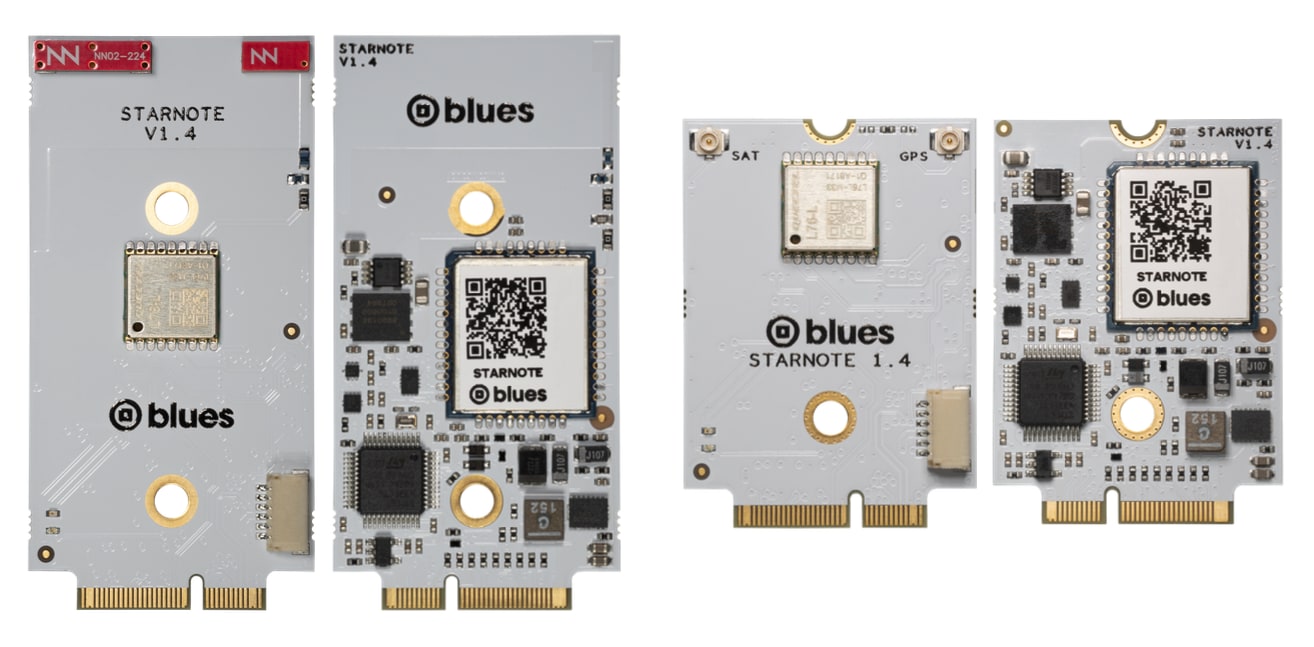
This article explores the fundamentals of Satellite IoT, introduces Non-Terrestrial Networks (NTNs), and details how Blues addresses satellite connectivity with its Satellite IoT module: Blues Starnote, a product that combines the power of cellular IoT with satellite into a seamless, developer-friendly solution.
Understanding Satellite IoT and NTN
Satellite IoT is a subset of a broader category called Non-Terrestrial Networks (NTNs). NTNs are wireless communication systems that rely on spaceborne (satellites), airborne (drones or high-altitude balloons), or maritime assets to provide connectivity. NTNs are being standardized under 3GPP to enable global coverage and integrate with 5G and future wireless technologies.
Within NTNs, satellite-based systems are the most mature and commercially viable for IoT applications. These systems typically consist of low Earth orbit (LEO) or geostationary Earth orbit (GEO) satellites that provide intermittent or continuous coverage across vast areas. LEO satellites, in particular, are well-suited for IoT because of their lower latency, reduced power requirements, and growing availability due to the rise of commercial providers such as Iridium, Globalstar, and emerging NTN IoT platforms like Skylo.
For IoT developers, NTNs represent a paradigm shift: you no longer have to rely solely on dense terrestrial infrastructure. Instead, you can deploy sensors and connected devices anywhere on the planet with confidence that they can still report back to your cloud or control system.
The Challenges of Truly Remote Connectivity
Connecting remote or mobile devices to the cloud has historically been expensive, power-hungry, and difficult to manage. Satellite solutions have long been available, but they were typically proprietary, involved complex licensing, required specialized hardware, and consumed too much energy to be viable for small, battery-powered IoT deployments.
The emergence of new LEO and GEO satellite constellations, along with advancements in narrowband communication protocols, have changed the game. Modern satellite IoT solutions are smaller, cheaper, and far more power-efficient, making them viable for real-world deployment at scale.
However, integration remains a challenge. Developers must still grapple with the logistics of dual-radio systems, fallback logic, device-to-cloud sync, security, and OTA update mechanisms.
That's where Blues and Skylo come in!
NTN Standards and Skylo
Skylo's network architecture is based on 3GPP Release 17 NTN standards, which extend existing cellular protocols like NB-IoT to operate over satellite links. This standardization means devices that already support narrowband cellular protocols can be upgraded to communicate over satellite without major hardware changes.
This evolution is critical. Legacy satellite communication systems relied on proprietary stacks and expensive, power-hungry radios. By contrast, NTN-based satellite IoT embraces the same low-power, low-bandwidth, secure communication patterns that cellular developers are already familiar with.
Skylo's NTN implementation uses geosynchronous satellites with dedicated beams optimized for narrowband signals. These beams cover massive geographic regions with relatively low energy requirements. It's a system that works well with small, energy-efficient modules like Blues Starnote, making it ideal for IoT deployments that require infrequent but reliable communication.
Introducing Blues Starnote
Blues Starnote is a purpose-built solution for Satellite IoT that eliminates the complexity traditionally associated with satellite communications. Designed as a companion to Blues Notecard, Starnote enables devices to seamlessly switch between cellular and satellite networks depending on availability.
When a Notecard is paired with a Starnote module, the device will attempt to communicate via cellular. If cellular connectivity is unavailable, the Notecard automatically falls back to satellite mode using the Skylo NTN network. This hybrid approach ensures continuous connectivity without requiring changes to application logic or firmware.

What makes this possible is the shared Blues developer ecosystem. All Notecards, including those paired with Starnote, use the same JSON-based API and sync data through Notehub, the secure cloud service provided by Blues. This means developers can design their product once and deploy it globally without worrying about regional network coverage or rewriting firmware to accommodate different communication protocols.
Developer Experience with Starnote
From a developer's perspective, working with Starnote is no different than any other Notecard. There is no satellite-specific API. You write JSON, send Notes (small arbitrary JSON objects), and let the hardware handle the rest.
For instance, adding a temperature reading looks like this:
{
  "req": "note.add",
  "file": "sensors.qo",
  "body": {
    "temp": 22.5,
    "units": "C"
  }
}
Now this part is important:
Whether that data is sent over LTE, WiFi, LoRaWAN, or over Skylo's NTN satellite link, the transport itself is abstracted away. You don't need to code failover logic. You don't have to implement retry strategies. The Notecard queues Notes and delivers them when connectivity, of any kind, is available.
You can also retrieve device status, signal strength, or last sync time. This uniformity is a massive time-saver and dramatically reduces the cognitive load for developers.
Technical Architecture
The Starnote module interfaces with a Notecard using a dedicated carrier board called a Notecarrier. Developers simply plug a Notecard and a Starnote into Notecarrier XS, which accommodates both modules in a compact and efficient form factor. This stack can then be connected to any microcontroller or single-board computer using USB or I2C.
Once installed, the Notecard automatically detects the presence of a Starnote and manages the fallback logic. From the developer's perspective, there's no need to write code to manage the failover process. You simply continue sending Notes to your Notecard as usual. If the device cannot connect over cellular, it will store those Notes until a satellite connection becomes available (or a cellular connection is reestablished).
This store-and-forward model ensures no data is lost, even when connectivity is intermittent. Data is eventually synced to Notehub, where it can be routed to any cloud endpoint and visualized using third-party dashboards like Datacake or Losant.
Satellite vs Cellular, LoRa, and WiFi
Satellite IoT fills a distinct role in the connectivity stack — providing coverage where terrestrial networks can't reach. Here's how it compares to the other major wireless IoT technologies:
| Technology | Range | Typical Idle Power | Bandwidth | Infrastructure | Best For |
|---|---|---|---|---|---|
| Cellular LTE Cat-1, Cat-1 bis, LTE-M, NB-IoT | Global (wherever cellular coverage exists) | ~8–18 µA @ 5V | ~60 KB to ~10 Mbps depending on protocol | Carrier networks (pre-existing) | Mobile, outdoor, or geographically distributed deployments |
| Satellite Skylo NTN, Iridium | Truly global, including oceans and remote wilderness | ~4 µA @ 5V for Starnote for Skylo | ~10–50 kbps (narrowband) | Satellite constellation (Skylo, Iridium) | Remote, off-grid, or cellular-dark locations; fallback for hybrid deployments |
| LoRaWAN 868 MHz EU, 915 MHz NA | Up to 15 km in rural line-of-sight; up to 5 km in urban | ~8 µA @ 5V | ~0.3–50 kbps (limited by duty cycle) | TTN gateway required | Dense, low-power sensor networks in a fixed geographic area |
| WiFi 2.4 GHz IoT class | ~30–50 m indoor (subject to walls and congestion) | ~14 µA @ 5V | Mbps class — highest bandwidth of the four | WiFi access point (pre-existing) | Indoor, high-bandwidth, infrastructure-present products |
Power Consumption and Battery Life
IoT developers obsess over power budgets, and for good reason. Battery life is often the primary limiting factor in field deployments.
We engineered Notecard for low-power operation, consuming just ~8-18uA@5V in idle mode. When paired with Starnote, the satellite link only activates during scheduled sync attempts or when triggered by firmware. This conserves energy and enables multi-year battery life even in remote, off-grid deployments.
In field scenarios where cellular coverage may be available during only parts of the day or week, this hybrid system further optimizes power usage by prioritizing cellular and reserving satellite transmission as a fallback.
Real-World Satellite IoT Use Cases
Blues has customers building on top of satellite IoT in a myriad of use cases. Here are some examples to help inspire your next product:
Wildlife Tracking: Devices embedded in animal collars can collect GPS coordinates, motion patterns, and even ambient temperature. These devices must last months or years and work far from cellular coverage. Blues Notecard and Starnote ensure these packets are logged and eventually delivered, even deep in the wilderness.
Disaster Recovery: When hurricanes or earthquakes disable terrestrial networks, first responder sensors still need to transmit structural or atmospheric data. Satellite fallback ensures uninterrupted communications, powering real-time awareness and quicker deployment of resources.
Agriculture: In vast farmlands or rangelands, cellular coverage may be sparse. Soil sensors, water flow meters, and livestock trackers can fall back to satellite when needed, giving farmers consistent access to field-level data.
Remote Industry: Asset tracking on oil rigs, mining trucks, and offshore infrastructure requires rugged, always-on connectivity. Starnote eliminates dead zones and extends asset visibility across continents and oceans.
The Future of Satellite IoT
As the demand for ubiquitous connectivity grows, Satellite IoT will only become more integral to the IoT landscape. With the rollout of NTN-compatible 5G standards, interoperability between terrestrial and non-terrestrial networks will become seamless. Expect to see tighter integration, improved bandwidth, and lower latencies.
For developers, the most important shift is that satellite IoT is no longer out of reach. With products like Blues Starnote, you don't need to be a satellite expert to build a satellite-enabled device. You don't need to write new code or redesign your application logic. You just plug in a module, use familiar APIs, and let the platform handle the rest.
The Blues Advantage
Blues brings a radically simplified approach to IoT connectivity. With a focus on developer experience, energy efficiency, and scalability, Blues products are engineered to eliminate the overhead and complexity that has historically burdened IoT developers.
All Notecards (whether cellular, WiFi, LoRa, or satellite-enabled) share the same core architecture:
- JSON-based APIs: No AT commands or proprietary SDKs.
- Plug-and-play modules: M.2 form factor for easy integration.
- Secure communication: Encrypted by default, no exposed public IPs.
- Long lifecycle: Idle current draw as low as ~8uA@5V.
What this means for developers is consistency. You can prototype with a Notecard WiFi and later swap in a cellular + satellite-enabled variant without rewriting your firmware. You can integrate with AWS, Azure, Snowflake, or your own HTTPS endpoint or MQTT broker using the same routing mechanisms. And you can manage thousands of devices in the field using Notehub's OTA update system and device fleet management tools.
Frequently Asked Questions
What is Satellite IoT?
Satellite IoT is the use of satellite communication networks to connect IoT devices that operate beyond the reach of terrestrial cellular, WiFi, or LoRaWAN infrastructure. Devices transmit and receive data through orbiting satellites, enabling connectivity in remote areas such as oceans, mountains, deserts, and rural expanses.
What is an NTN (Non-Terrestrial Network)?
A Non-Terrestrial Network is a wireless communication system that relies on spaceborne (satellites), airborne (drones, balloons), or maritime assets to provide connectivity. NTNs are being standardized under 3GPP Release 17 to enable global coverage and integrate with 5G and future wireless technologies.
Does Blues Starnote work without cellular coverage?
Yes. When paired with a Notecard, Starnote attempts cellular first; if cellular is unavailable, the Notecard automatically falls back to satellite via the Skylo NTN network. This hybrid approach ensures continuous connectivity without requiring changes to application logic or firmware.
How much power does Starnote use?
Starnote is engineered for low-power operation. Notecard idles at ~8–18 µA at 5V; when paired with Starnote, the satellite link only activates during scheduled sync attempts or when triggered by firmware. This enables multi-year battery life in remote, off-grid deployments.
What satellite network does Starnote use?
Starnote for Skylo uses the Skylo NTN network, built on 3GPP Release 17 NTN standards, which extend cellular NB-IoT protocols to operate over satellite links. Blues also offers Starnote for Iridium for alternate coverage profiles.
How much does satellite IoT data cost with Starnote?
All Blues satellite products (Notecard for Skylo, Starnote for Skylo, and Starnote for Iridium) include a fixed lifetime data allocation for both inbound and outbound traffic. Once exhausted, additional usage is billed monthly. Per-packet billing is based on minimum and maximum packet size per network: Iridium uses 10 to 10,000 bytes; Skylo uses 50 to 256 bytes.
Do I need to write separate code to handle cellular vs satellite fallback?
No. The Notecard automatically detects the presence of a Starnote and manages failover logic. From the developer's perspective, there is no separate satellite API — you continue sending JSON Notes to the Notecard as usual, and the hardware handles network selection and store-and-forward.
Conclusion and Next Steps
Building and scaling a global IoT solution is hard. Blues makes it easier. The combination of Notecard, Notehub, and Starnote creates an end-to-end architecture that developers can rely on, whether deploying a dozen devices or a global fleet.
You don't need to negotiate cellular or satellite contracts. The data plan is prepaid. You don't need to provision SIMs, manage keys, or write glue code to integrate with your backend. The data flows securely, automatically, and in a developer-friendly format.
With Notehub, you can visualize device data, troubleshoot sync events, push firmware updates, and manage fleets at scale. Whether you're an individual developer or part of a Fortune 500 company, the same infrastructure is available to you.
Visit blues.com to learn more, or just start building with a Starnote for Skylo Starter Kit and our complete developer documentation.
