What are LoRa and LoRaWAN? A Developer Guide

Key Takeaways
- LoRa is the radio, LoRaWAN is the network. LoRa is Semtech's physical-layer chirp-spread-spectrum protocol; LoRaWAN is the open networking layer built on top of it.
- Long range, low power, small payloads — LoRaWAN reaches 10+ km in rural line-of-sight and supports multi-year battery life, at the cost of narrow bandwidth (~0.3–50 kbps) and duty-cycle limits.
- Blues Notecard for LoRa brings the same JSON API and Notehub integration used by Cellular and WiFi Notecards, with ~8 µA idle draw.
- Gateway required — use the Blues Indoor LoRaWAN Gateway, a public network like The Things Network, or your own private deployment.
Introduction
In the rapidly evolving landscape of the Internet of Things (IoT), wireless connectivity remains the most crucial enabler. From low-latency broadband use cases to ultra-low-power, long-range sensing applications, each scenario demands a different connectivity approach. For developers and organizations building power-efficient, long-range wireless solutions, LoRa and LoRaWAN have emerged as vital tools in the connectivity arsenal.
This article serves as a look at LoRa and LoRaWAN technologies and how they enable transformative IoT applications. It also explores how Blues, a company dedicated to eliminating the friction in wireless IoT connectivity, supports LoRa/LoRaWAN deployments with its innovative LoRa dev board: Notecard for LoRa, LoRaWAN gateway, and secure cloud infrastructure.
Start with the Basics: LoRa vs LoRaWAN
LoRa and LoRaWAN are often used interchangeably, but they refer to distinct layers in the IoT connectivity stack. LoRa, short for Long Range, is a proprietary physical layer (PHY) protocol developed by Semtech. It modulates data using Chirp Spread Spectrum (CSS) techniques to achieve low power consumption over long distances, making it ideal for battery-powered devices in remote areas.
LoRaWAN, on the other hand, is an open networking protocol that operates on top of LoRa. It defines how devices communicate with gateways and how those gateways relay data to a centralized network server, such as The Things Stack. LoRaWAN standardizes security, data rates, and frequency plans, enabling interoperability across devices and platforms.
To summarize: LoRa is the radio, LoRaWAN is the network.
A Brief History of LoRa and LoRaWAN
LoRa began its journey in the early 2010s when a French startup named Cycleo developed the technology. Semtech acquired Cycleo in 2012 and began commercializing the LoRa chipsets that would go on to power millions of devices. In 2015, the LoRa Alliance was formed to promote the standardization and global adoption of the LoRaWAN protocol.
The alliance brought together hundreds of members ranging from chipset manufacturers and device makers to network operators and cloud service providers. With their collaboration, LoRaWAN matured into a robust open specification that supports millions of devices globally, particularly in Europe, North America, and Asia.
How LoRaWAN Works
LoRaWAN operates in a star topology where end devices communicate with gateways that connect to a central network server. LoRaWAN defines multiple device classes:
- Class A devices are the most energy-efficient, initiating communication only when necessary.
- Class B devices offer scheduled receive windows.
- Class C devices remain open for communication almost continuously, drawing more power.
Devices can send uplinks (sensor data) and receive downlinks (commands or updates) using either confirmed or unconfirmed messages. Confirmed messages include an acknowledgment, ensuring data delivery but consuming more airtime.
The protocol supports adaptive data rate (ADR), dynamically adjusting data rates and transmission power to optimize battery life and network capacity. Spreading factors range from SF7 to SF12; higher factors increase range but reduce data rate.
Because LoRaWAN operates in unlicensed ISM bands (868 MHz in Europe, 915 MHz in North America), developers must also adhere to duty cycle limitations. These regulations prevent any one device from monopolizing the airwaves, ensuring fair use across deployments.
LoRaWAN vs Cellular, Satellite, and WiFi
LoRaWAN occupies a specific niche in the IoT connectivity landscape, optimized for long-range, low-power, fixed-site deployments. Here's how it compares to the other major wireless IoT technologies:
| Technology | Range | Typical Idle Power | Bandwidth | Infrastructure | Best For |
|---|---|---|---|---|---|
| Cellular LTE Cat-1, Cat-1 bis, LTE-M, NB-IoT | Global (wherever cellular coverage exists) | ~8–18 µA @ 5V | ~60 KB to ~10 Mbps depending on protocol | Carrier networks (pre-existing) | Mobile, outdoor, or geographically distributed deployments |
| Satellite Skylo NTN, Iridium | Truly global, including oceans and remote wilderness | ~4 µA @ 5V for Starnote for Skylo | ~10–50 kbps (narrowband) | Satellite constellation (Skylo, Iridium) | Remote, off-grid, or cellular-dark locations; fallback for hybrid deployments |
| LoRaWAN 868 MHz EU, 915 MHz NA | Up to 15 km in rural line-of-sight; up to 5 km in urban | ~8 µA @ 5V | ~0.3–50 kbps (limited by duty cycle) | TTN gateway required | Dense, low-power sensor networks in a fixed geographic area |
| WiFi 2.4 GHz IoT class | ~30–50 m indoor (subject to walls and congestion) | ~14 µA @ 5V | Mbps class — highest bandwidth of the four | WiFi access point (pre-existing) | Indoor, high-bandwidth, infrastructure-present products |
Why LoRa and LoRaWAN for the IoT?
LoRaWAN excels in scenarios where devices need to transmit small packets of data over long distances while consuming minimal power. These characteristics make it ideal for smart agriculture, environmental monitoring, remote asset tracking, and smart cities. With range capabilities often exceeding 10 kilometers in rural areas and battery life extending beyond 5 years, it's not surprising that LoRaWAN has been adopted globally.
The technology is license-free, operating in the ISM (Industrial, Scientific, and Medical) bands, such as 868 MHz in Europe and 915 MHz in North America. This lowers deployment costs and accelerates time-to-market.
In terms of total cost of ownership, LoRaWAN is hard to beat. No SIM cards, no monthly fees, and the ability to deploy your own private network make it an attractive option for developers and enterprises alike. LoRaWAN is also resilient in noisy RF environments thanks to its chirp spread spectrum modulation, which can recover signals below the noise floor.
Developers can choose between public LoRaWAN networks (offered by providers like Helium and The Things Network) or deploy private networks tailored to specific geography, security requirements, or performance needs.
Blues is Simplifying LoRa/LoRaWAN with Notecard for LoRa
At Blues, we're working to solve the problem of wireless IoT connectivity, once and for all. Our Notecard product line was created to help you connect any device to any cloud using any MCU or language, and with the lowest friction possible. While we are best known for our globally available, prepaid cellular IoT Notecards, our portfolio includes LoRa support that brings the same simplicity and security to long-range, low-power networks.
Blues Notecard for LoRa is a 30x35mm system-on-module that provides developers with a plug-and-play LoRaWAN experience.
| Front of Notecard for LoRa | Back of Notecard for LoRa |
|---|---|
 |  |
Like its cellular and WiFi siblings, it features:
- A shared developer API that uses JSON for control and data payloads.
- Ultra-low idle power draw (8µA@5V).
- Secure communications with LoRaWAN.
- Seamless synchronization with any cloud endpoint via Blues Notehub.
By abstracting the complex parts of LoRaWAN configuration, routing, and fleet management, Notecard for LoRa makes LoRa-based IoT just as accessible as its cellular, WiFi, and satellite IoT counterparts.
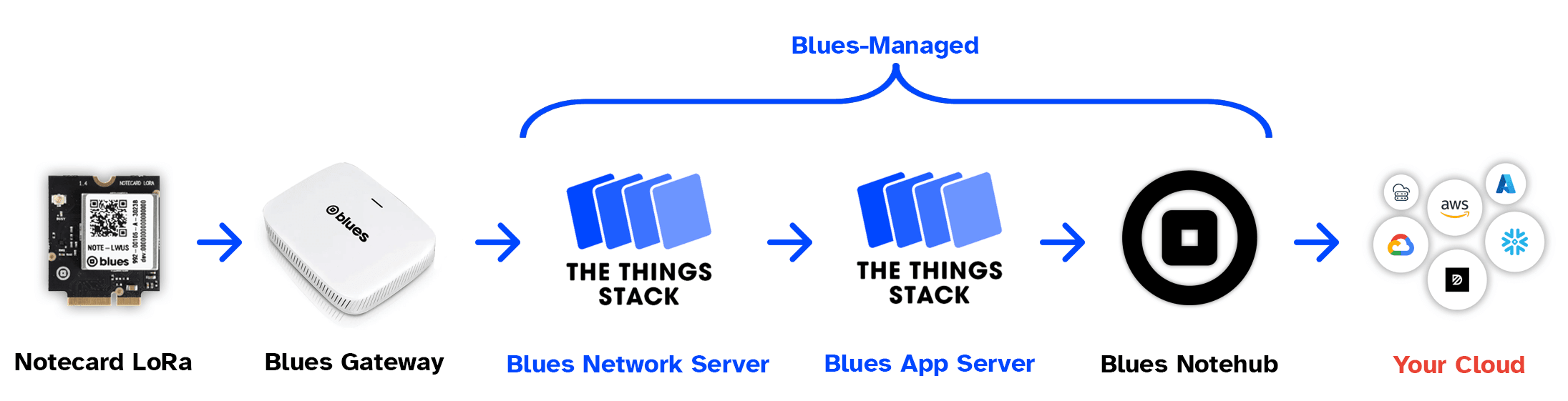
Notecard with a LoRaWAN Gateway: The End-to-End Picture
To connect to a LoRaWAN network, you need a gateway: an intermediary that receives LoRa transmissions and forwards them to a network server. Blues offers an Indoor LoRaWAN Gateway purpose-built for developers and commercial deployments. It connects devices using Notecard for LoRa to the LoRaWAN network servers provided by The Things Stack, which Blues officially supports.
The Blues Indoor LoRaWAN Gateway is compact, easy to set up, and supports both Ethernet and WiFi backhaul. With it, you can quickly stand up your own LoRaWAN network, ideal for localized deployments like agricultural fields, manufacturing floors, or campus environments. Once your gateway is online, it acts as the bridge between your Notecard for LoRa devices and Notehub, or another network server of your choosing.
This modular approach (Notecard for LoRa, an indoor or outdoor LoRaWAN gateway, and Notehub) creates a powerful stack for building scalable, secure, and low-power IoT solutions.
The Role of Notehub in LoRa Deployments
We've mentioned Notehub a few times now, but have yet to really explain what it is!
Notehub is Blues' secure cloud service that provides a thin layer between your devices and your ultimate cloud destination. When used with Notecard, Notehub manages data routing, performs secure syncs, and enables bi-directional control, allowing developers to:
- Send Notes (JSON payloads) from the edge to the cloud.
- Configure environment variables on Notecards remotely.
- Route device data to third-party services like AWS, Azure, Google Cloud, or custom HTTPS or MQTT endpoints.
And because Notehub is a hosted service, you don't need to provision, secure, or maintain your own LoRaWAN network server. However, for developers who prefer using The Things Stack with their own gateway, Notecard for LoRa integrates cleanly thanks to support for standard LoRaWAN device provisioning and uplink/downlink behaviors.
Developer Walkthrough of Notecard for LoRa
Let's walk through what the first 10 minutes with Blues and LoRa/LoRaWAN looks like for an embedded/IoT developer.
-
You start by selecting the Notecard for LoRa and mounting it on a Notecarrier that matches your preferred form factor. This might be a Notecarrier A, or a Notecarrier Pi for Raspberry Pi compatibility, or a Notecarrier F if using an Adafruit Feather-compatible host MCU.
-
Next, power on the Blues Indoor Gateway and follow the quickstart to join it to your local network. The gateway is automatically registered with The Things Stack, LoRaWAN credentials are configured for you, and you just need to associate your Notecard with a specific project on Notehub (like with any other Notecard).
-
Once Notecard for LoRa powers-on, it joins the network and you can start sending Notes (small arbitrary JSON objects) to Notehub via the gateway. On Notehub, you can inspect your incoming data, configure routing to AWS, Azure, Datacake, or any HTTPS or MQTT endpoint, and even send downlink variables to the device.
In minutes, you're wirelessly syncing data from the edge to the cloud, no LoRaWAN packet formatting or RF configuration required!
Architectural Patterns and Future Outlook
It's important to note that Blues supports a wide variety of architectural patterns due to the innovative nature of Notecard for LoRa alongside the entire Notecard ecosystem. This includes:
- Star topology where multiple Notecard for LoRa devices connect to a single local gateway.
- Edge aggregation patterns where a host MCU performs analytics and transmits summaries.
- Multi-radio systems using Notecard for LoRa alongside Notecard Cellular and Notecard WiFi, enabled by the common API.
This flexibility allows developers to design systems with intelligent fallback, reduced airtime usage, and cost-aware routing.
Looking at the future, LoRaWAN isn't standing still. Emerging capabilities such as Long Range Frequency Hopping Spread Spectrum (LR-FHSS) promise higher capacity networks. Class B support is gaining traction, unlocking new use cases requiring latency balance.
Blues continues to follow these developments closely, ensuring the Notecard for LoRa remains compatible and forward-looking. Meanwhile, partnerships with platforms like The Things Stack reinforce our commitment to staying aligned with the ecosystem's trajectory.
Frequently Asked Questions
What is the difference between LoRa and LoRaWAN?
LoRa is the physical-layer radio protocol developed by Semtech, using Chirp Spread Spectrum modulation for long-range, low-power transmission. LoRaWAN is the open networking protocol that operates on top of LoRa, standardizing how devices communicate with gateways and how gateways relay data to network servers. In short: LoRa is the radio, LoRaWAN is the network.
How far can LoRaWAN reach?
LoRaWAN range often exceeds 10 kilometers in rural areas with line-of-sight, and can stretch further at the lowest data rates. In urban environments, realistic range is typically 2 to 5 km depending on building density. Higher spreading factors (SF7 through SF12) extend range but reduce throughput.
Do I need my own LoRaWAN gateway?
Not necessarily. You can use public LoRaWAN networks like The Things Network or Helium, or deploy your own gateway. Blues offers an Indoor LoRaWAN Gateway purpose-built for developers; it registers automatically with The Things Stack and works out of the box with Notecard for LoRa.
What frequencies does LoRaWAN use?
LoRaWAN operates in unlicensed ISM bands — 868 MHz in Europe and 915 MHz in North America, with regional variations. Because these bands are shared, developers must respect duty-cycle limitations that cap how much airtime any one device can use.
How long can a LoRaWAN device run on a battery?
Battery life typically exceeds 5 years in field deployments, thanks to LoRa's low-power transmission and LoRaWAN's Class A device scheduling (where the device only wakes to send uplinks). Notecard for LoRa idles at ~8 µA at 5V, maximizing battery life further.
What are LoRaWAN device classes?
Class A devices are the most energy-efficient, initiating communication only when necessary. Class B devices offer scheduled receive windows for predictable downlink timing. Class C devices remain open for near-continuous communication, drawing more power but enabling low-latency commands.
Can I use the same firmware across cellular, WiFi, and LoRa Notecards?
Yes. All Blues Notecards share the same JSON API. You can swap between Notecard Cellular, Notecard WiFi, and Notecard for LoRa without rewriting your firmware — only the carrier hardware changes.
Conclusion and Next Steps
LoRa and LoRaWAN offer incredible advantages for IoT deployments that demand low power consumption and long-range communication. However, integrating these technologies has traditionally come with a steep learning curve.
Blues changes that. With Notecard for LoRa, the Blues Indoor LoRaWAN Gateway, and the powerful Notehub cloud service, developers can skip the complexity and get to value faster. Whether you're building a smart agriculture solution or a scalable industrial sensor network, Blues provides the hardware, software, and cloud infrastructure to make LoRa IoT development not only possible but efficient, secure, and scalable.
And because all Notecards share the same API, switching between connectivity types, or building hybrid solutions, has never been easier!
Visit blues.com to learn more, or just start building with a LoRaWAN Starter Kit and our complete developer documentation.
