
Notehub IQ has been out for a few weeks now, and I've been using it on my own projects nearly every day since.
If you haven't tried it yet, the short version is this: Notehub IQ lets you ask questions about your deployed devices in plain language, from an LLM client you already use.
 tip
tipNew to Notehub IQ? Watch our intro video, and then follow the short walkthrough in Notehub MCP to try it yourself.
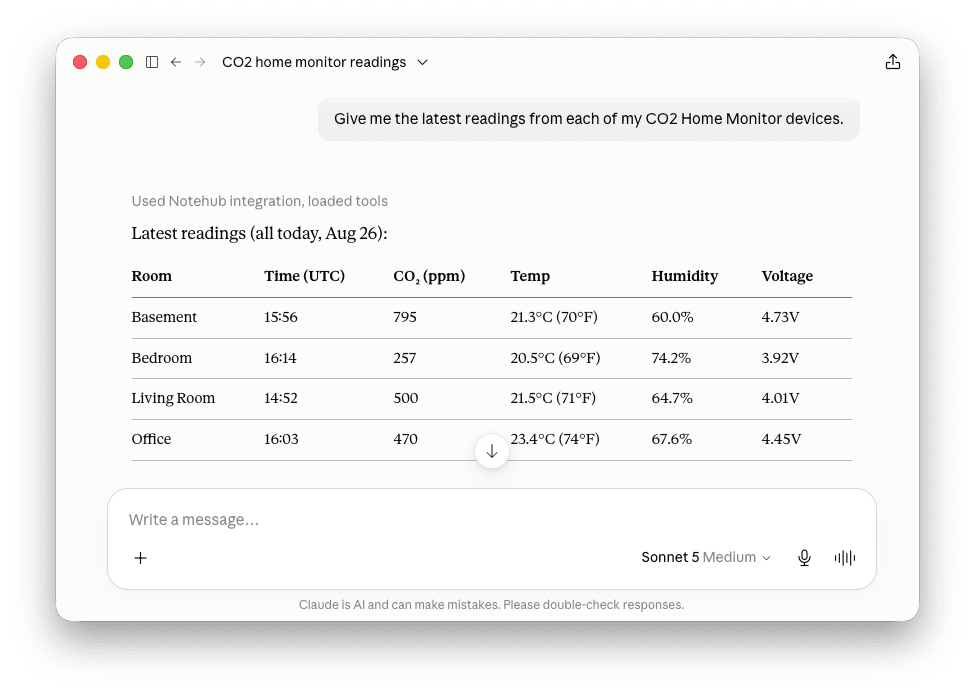
I started using Notehub IQ by asking relatively simple questions about my device data (which is exactly what I did in the screenshot above). Since then though, I’ve found that I’ve gotten the most value out of Notehub IQ by building workflows and automations—and, I’ve found that building those workflows relies on having the right data and context available.
In this blog post I’m going to help you build similar automations by sharing what I’ve learned in the form of a few quick tips & tricks. Let’s get started.
Create a Dataset for Your Session Data
When you onboard a project, Notehub MCP will prompt you to create datasets from the Notefiles you have on your Notehub project. For example, here’s the prompt I got when onboarding a testing project I run, AirIQ.
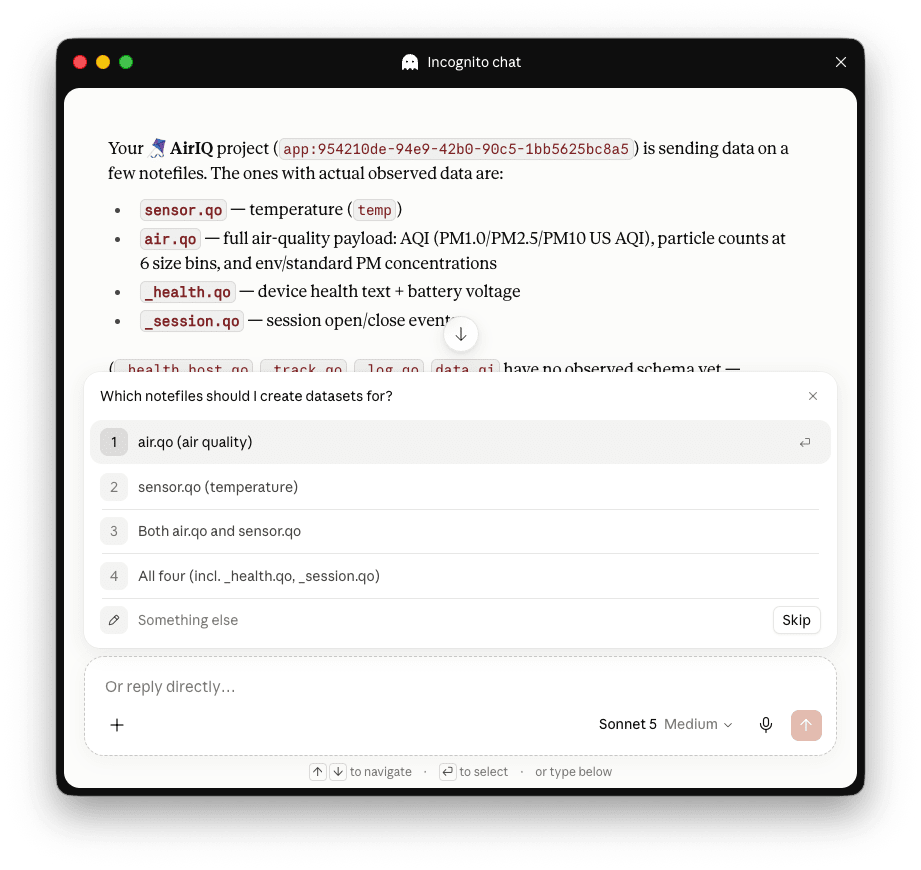
Although Notehub MCP and your LLM will make dataset recommendations, ultimately which datasets you choose to use with Notehub IQ is up to you.
And my tip here is: I strongly encourage you to create a dataset that includes session data. In the Blues ecosystem a new _session.qo Note is created each time a session between a Notecard and Notehub begins and ends. And those _session.qo Notes contain a wealth of valuable metadata about your devices, for example:
- Battery voltage
- Temperature: the temperature as measured by Notecard’s onboard temperature sensor
- Signal quality: bars, RSSI, SINR, RSRP, and RSRQ on cellular
- Data usage: bytes sent and received, Notes synced, and how long the session lasted
- Firmware versions: for both the Notecard and your host
- Location: All the locations your Notecard knows about (cell tower, triangulated, GPS)
If you create a dataset from _session.qo suddenly a whole new category of questions becomes answerable. For example:
Which of my devices have used the most cellular data in the last month?
How many devices do I have with poor signal strength?
Are all of my devices using the same Notecard firmware and host firmware?
tipYou can create new datasets using Notehub MCP at any time, not just when onboarding a project. Just ask your LLM:
I want to create a session dataset for my
<name of your project>Notehub project from my_session.qodata.
Having session data also opens the door to some interesting experiments. For example, suppose you want to push out new host firmware to your devices, but you’re worried about any unintentional consequences. With session data available in Notehub IQ, you could push out the update to a small handful of devices, and then start asking questions like:
I pushed out a new host firmware update (2.0) to a few devices. I want to compare devices running 2.0 to devices running 1.0. Compare power usage, data usage, and the numbers of Notes sent/received.
With the amount of useful metadata in session Notes, I’m sure there are other powerful queries you could run—especially on large projects. (If you have any tips let us know on our community forum).
Next, though I want to share my most valuable tip.
Put Your Firmware in Context
Getting good answers from an LLM often depends on context. If you ask an LLM for an exercise plan for your shoulder, you’ll get way different answers if you include a doctor’s report from a recent injury.
Similarly, adding context can help you get good answers from Notehub IQ. Notehub IQ already knows about system Notefiles (_session.qo, _health.qo, etc), but it doesn’t know about your application data. And even if your data is relatively simple, the LLM can benefit from knowing exactly how that data gets generated.
That all brings me to my tip: put your firmware in context. Specifically, when you ask Notehub IQ questions, make sure it also knows about your project’s firmware and where it’s located.
Virtually all AI tools provide a way to either ask questions within a folder, or to add folders that should be in context to help with your questions. For example, in Claude Desktop you can add folders from the Cowork tab.
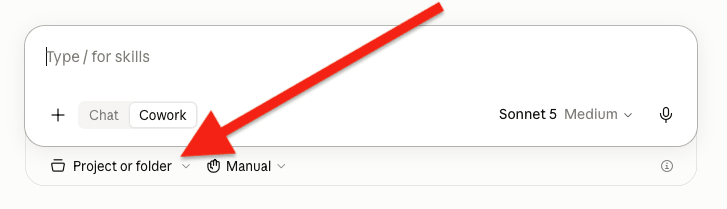
And in ChatGPT/Codex you can choose a project to work within (where a project is basically just a folder).
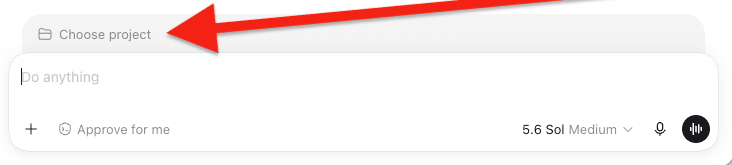
Interestingly, the most interesting thing I’ve discovered since doing this is firmware bugs. For example, Notehub IQ helped me realize the alerting logic I was using for a separate sample of mine, TempTrack, was wrong, and I was sending alerts when I shouldn’t have. Notehub IQ also helped my coworker, Rob Lauer, find an incorrectly configured voltage-variable value in his Notecard configuration.
The more Notehub IQ knows about your project the better, so to broaden my tip, consider putting documents about how your project works, datasheets of your PCBs and components, etc in the context folder as well. For an example of the structure I’m now using, you can refer to my sample AirIQ and TempTrack projects on GitHub, which both use the following structure.
.
├── config.json
├── firmware
├── README.md
└── webapp
And here’s what’s in those files:
config.json: My Notecard configuration in the form of a setup script.firmware: The source code for my project’s host firmware.README.md: A description of my project, including a complete list of hardware components.webapp: A dashboard web application I use for managing my project’s devices.
Modern LLMs have no trouble managing all of these files in their context, especially when you provide a README that maps out what each of the files and folders are and provide a short description.
As someone that builds a lot of small samples, I can definitely say this using this structure is incredibly powerful when you’re developing a complete product. When an LLM is able to cross reference your firmware, your dashboard, and the real data in Notehub, it can make some seriously powerful suggestions to help you optimize the performance and reliability of your devices.
And this power becomes even more valuable when you set up checks that run on a regular interval.
Create Scheduled Tasks
Notehub IQ can give you valuable information about your data and your projects, but if you rely on manually asking questions you’ll likely miss signals in your data that require more immediate attention.
The solution to this is to add in some automation, and to create tasks that leverage Notehub IQ and that run at regular intervals.
Claude and Codex both call these scheduled tasks (Claude docs, Codex docs), GitHub Copilot and Cursor both call these automations (GitHub Copilot docs, Cursor docs), but they all do the same thing—let you run prompts at a configurable interval.
I set up scheduled tasks for another sample project of mine (I have a lot of them), a CO2 home monitor.
In short, I have four devices scattered around my home that report hourly CO2 and voltage readings, and there are really only two things I care to know from this data: 1) is the CO2 high enough that I should ventilate a room, and 2) is one of my devices low on battery.
To do that I created a schedule task in Claude Desktop with the following prompt:
Create a new scheduled task that runs hourly. The task should check the CO2 Home Monitor Notehub project and get the latest CO2 and voltage readings for each device. If any device has a CO2 above 1500, send me a Slack DM telling me which device(s) have high CO2, and what the values are. If any device has low voltage, send me a Slack DM telling me which devices I need to charge. Don’t send me multiple Slack messages about the same device in a 6-hour window.
The real power is that I was able to do all this by essentially rambling through my keyboard in a few sentences. There are plenty of systems that send alerts (we even have one in Notehub), but nothing that exists lets me approach this level of customizability. I was able to create a task that runs at a scheduled interval, with multiple conditions, with rate limiting, and it just works.
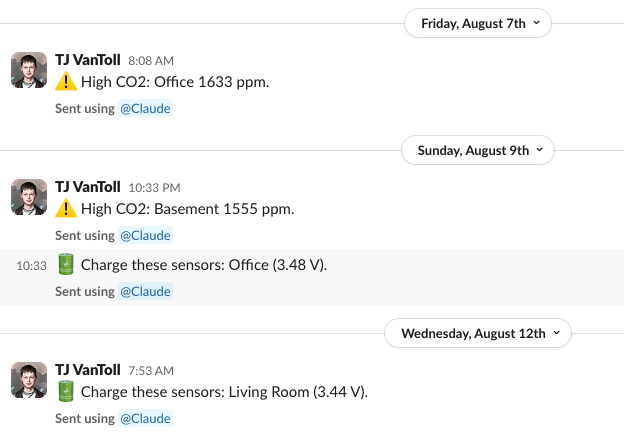
Perhaps the crazier thing is that when I want to switch how my scheduled task works, all I have to do is ask my LLM. For example, I’ve since adjusted my task to also handle devices that haven’t reported in 24 hours.
Adjust my CO2 monitor scheduled task. Add a check for devices that have reported no data for the last 24 hours. Use the same Slack notifications for sending alerts.
And I unexpectedly got to test those alerts later that week, when a construction company dug up and tore the fiber line that brings the internet to my house. (Three of the devices on that project use WiFi; my fourth device was on cellular and kept working fine.)
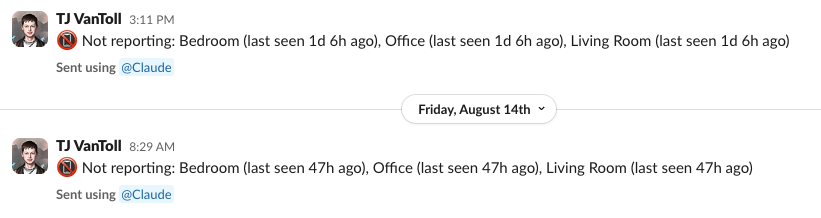
What you choose to automate depends on your project and what you’re doing with it. But I feel like everyone can benefit from a regularly scheduled process that checks in on your devices and looks for abnormal behavior.
And that’s especially true if you connect your tasks to other services.
Leverage Other MCP Servers
Building an MCP server is a popular thing to do in 2026. We’re doing it with Notehub, and a long, long list of other services are doing so as well.
Although there’s a lot of noise in that long list, there are a lot of MCP servers from services your company may be using, and which you can leverage as part of your automations.
For example, the previous section’s automation uses Slack’s MCP server as a way of notifying me of devices that need my attention. If I wanted to send text messages instead I could use Twilio’s MCP server; or if I wanted to send emails I could use the Gmail MCP server or the Microsoft 365 MCP server.
Another common workflow we’re experimenting with is automated ticket creation. My coworker, Alex Bucknall, used Atlassian’s MCP server to automatically create and manage Jira tickets based off Notehub data in a webinar we held last week. You could do the same with GitHub’s MCP if you use GitHub for issue tracking.
Overall, we see a lot of potential in using Notehub IQ alongside other services you’re already using, and more options are becoming available for this every day.
 note
noteOh, one more—at Blues we actually have two MCP servers. Blues Expert MCP gives your LLMs the ability to search the Blues documentation, can perform Notecard API request validation, and can help you write host firmware as well. It works well alongside Notehub IQ, so try it out!
Wrapping Up
In just a month, Notehub IQ has transformed the way I think about working with data in connected products. I’m repeatedly amazed at what I can accomplish and learn by just talking to my LLM about my devices.
In this blog post I’ve shared a few of the things that have helped me. If you have any tips you’d like to share, or just want to let us know how Notehub IQ has been going for you, let us know in our forum.
Notehub IQ is free to use during its public beta, so if you haven’t tried it yet go ahead and check out the Notehub IQ documentation to try it out yourself. It’s as simple as adding a single MCP server to your AI tool of choice, so you should be up and running within a few minutes.
Or heck, it’s 2026, and you’re probably not reading documentation anymore. So, maybe just tell your LLM to do this too:
I’ve heard that Notehub IQ is, like, really powerful. Help me install Notehub MCP so I can get started.
