Blues Starnote® Datasheet: Starnote for Iridium
Starnote for Iridium is an affordable satellite IoT backup device for NTN (Non-Terrestrial Networking) communications.
Blues Starnote for Iridium is a low-cost, reliable, developer-accessible device that eliminates the complexity of adding satellite connectivity to any solution. As a cost-optimized "Notecard accessory", Starnote for Iridium only functions when used alongside a paired Notecard.
Starnote for Iridium is intended to disrupt the conventional wisdom that using satellite IoT requires a significant hardware investment and monthly device fees, even when devices aren't actively communicating with satellites.
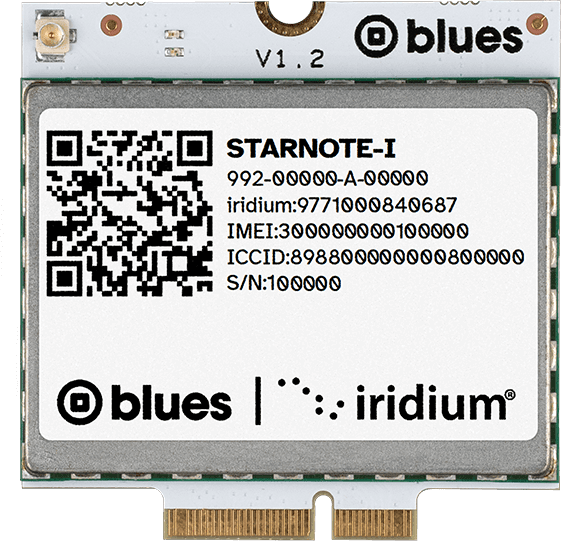
Functional Description
As an accessory, Starnote for Iridium does not function like a standalone Notecard. Rather, Starnote for Iridium is paired with a Notecard and works alongside a Notecard Cellular, Notecard Cell+WiFi, or Notecard WiFi device (Notecard for LoRa is not supported for use with Starnote for Iridium).
From a developer's point of view, Starnote for Iridium operates as an additional available RAT (Radio Access Technology) for Notecard. The developer uses the Notecard API to specify the Notecard's mode of operations for when to fall back to satellite, and Notecard handles all communications between itself and Starnote for Iridium.
Starnote for Iridium has a Notecard-like shape (though much wider) and it uses the same M.2 connector as Notecard. However, the position of the mounting hole makes it unmountable on Notecarriers that are intended for Notecards only.
Starnote for Iridium is only compatible with the Notecarrier XI and is not intended for use with any other Notecarrier.
Satellite (NTN) Communications
Blues is partnering with Iridium to provide NTN (Non-Terrestrial Network) capabilities for Starnote for Iridium. Iridium is a satellite communications company that operates a global LEO (Low Earth Orbit) constellation providing connectivity anywhere, including oceans, polar regions, and other remote areas.
Starnote for Iridium packets have a minimum size of 10 bytes and support a Maximum Transmission Unit (MTU) of up to 10,000 bytes for packets sent to the satellite and 340 bytes for packets received from it. Starnote for Iridium uses the Iridium 9704 module operating in the L-band and requires a dedicated Iridium satellite antenna for connectivity. The Starnote for Iridium u.FL connector must be used with the Iridium-certified L-band antenna supplied with the device.
Features
- Global coverage. Provides blanket satellite coverage globally.
- Integrated. M.2 Key E connector is provided for board-to-board usage.
- Built to minimize data usage. Bundled with 10KB of satellite data from Iridium. Additional data is priced $0.00075/byte, with a minimum of 10 bytes per transmitted or received satellite data packet, billed monthly in arrears.
- Simple. Starnote for Iridium provides an NTN-capable satellite modem with zero-touch configuration. Starnote for Iridium uses Notecard's JSON command interface and communicates with a Notecard over UART.
- Hassle-free. No satellite provider subscriptions, fees, or monthly minimums apply.
Package Configuration
- Product Name: Starnote for Iridium
- NTN Module: Iridium Certus™ 9704 Module
- GPS/GNSS Module: Quectel L76L-M33
- Data Networks: Iridium® satellite network, L-band (1616 MHz–1626.5 MHz)
- Supported Regions: Global
- Data included: 10KB
Module Datasheet
Block Diagram
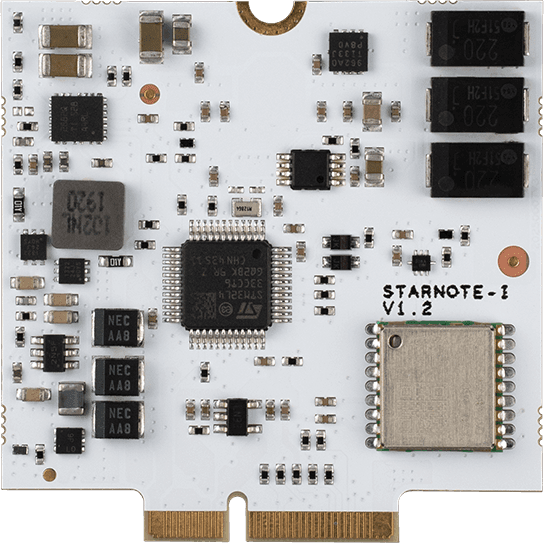
3D models for Starnote for Iridium are available on GitHub, making it a straightforward task to embed a Starnote for Iridium and its paired Notecard into a broad variety of host device designs.
| Front | Back |
|---|---|
|  |
Typical Application
Starnote for Iridium is meant to be used alongside a Cellular, Cell+WiFi, or WiFi Notecard in a fallback (failover) capability. The Starnote for Iridium's paired Notecard is programmed by the developer to facilitate efficient failover to satellite data utilizing the same Notecard API they are already using, while minimizing consumption of satellite data.

Key Features
Starnote for Iridium provides a new, expanded connectivity option for Notecard-powered solutions, enabling the following capabilities:
-
Global Coverage
Starnote for Iridium ensures truly global connectivity across remote, rural, maritime, and polar regions, delivering coverage that terrestrial networks cannot reach. This makes it ideal for applications such as maritime asset tracking, remote environmental and agricultural monitoring, and global logistics and supply chain visibility anywhere on Earth.
-
Interoperability
Since Starnote for Iridium requires a paired Notecard to function, developers continue using the same Notecard API while making only minor firmware changes to enable satellite connectivity.
-
Cost-Effectiveness
Starnote for Iridium is a low-cost satellite IoT option that includes 10 KB of satellite data from Iridium. Additional data is billed at $0.00075 per byte. Each transmitted or received satellite data packet is billed as at least 10 bytes, regardless of actual payload size, and may not exceed 10,000 bytes when sent or 340 bytes when received. Usage is billed monthly in arrears.
Power Information
Starnote for Iridium's main supply voltage (VMODEM_P) powers the satellite
subsystem (an Iridium 9704 module) and its associated circuitry, and is supplied
at a nominal 4.83V. Starnote for Iridium re-regulates VMODEM_P on-board with a
buck-boost converter that generates the internal rail feeding the satellite
modem.
When idle, the Starnote draws minimal current. However, the Iridium 9704's power
amplifier draws large current bursts during transmit, and the internal power path
is dimensioned for these high peak currents. As a result, VMODEM_P must be a
constant supply that can source the modem's transmit bursts without sagging. A
battery or general-purpose regulator sized only for average current often cannot
source these bursts directly, so the Notecarrier XI reference design feeds
VMODEM_P from a buck-boost supercapacitor charger/balancer that uses
supercapacitors as a local energy reservoir. See the
Starnote Carrier Board Design Guide
for guidance on replicating this supply. It is also recommended that PCB traces
for VMODEM_P and GND be designed to handle high peak current.
The Starnote's logic voltage (VIO_P) is provided by the Notecarrier or host
system for digital communication; it will be either 1.8V or 3.3V. This supply
powers the on-board STM32U575 MCU, the host-facing side of the level shifters, and
associated pull-ups. The GPS module is powered from the internal, VMODEM_P-derived
rail rather than from VIO_P.
| Pin Name | Direction | Pin Numbers | Usage |
|---|---|---|---|
| GND | -- | 3,5,6,11,18,33,39,45,51,57,71,73 | Ground |
| VIO_P | IN | 2,4 | 1.8V or 3.3V (STM32U575 + host side of level shifters + pull-ups) |
| VMODEM_P | IN | 70,72,74 | 4.83V nominal; constant supply that must source high transmit-burst current (re-regulated on-board to power the Iridium 9704 and GPS module) |
Reset and Loss of Power
 warning
A power-loss event occurs whenever the Starnote loses power on VIO_P or
VMODEM_P, or the Starnote's RST pin is pulled low. The satellite modem is
designed to use best efforts to maintain integrity when recovering from a
power-loss event. That said, there is a small chance that recovery will be
impossible and the modem will be rendered permanently unusable.
It is the responsibility of every product designer to ensure that designs
utilizing Starnote provide constant power to VMODEM_P and VIO_P so as to
ensure that power-loss events do not occur as a matter of course.
Antenna Requirements
Starnote for Iridium includes a single u.FL connector for use with the included Iridium-certified antenna, which supports both satellite and GPS/GNSS connectivity. The antenna must be installed outdoors with a clear view of the sky.
warningStarnote for Iridium is certified on Iridium's network exclusively with the antenna provided. If you replace or modify the antenna, Iridium classifies the device as uncertified and may block it.
Should you wish to pursue Iridium certification with a different antenna, please reach out to Blues for guidance.
Regardless of antenna choice, we strongly advise comprehensive field testing in the final enclosure and deployment environment to ensure reliable connectivity.
Antenna Performance
Actual RF performance of Starnote for Iridium depends on a variety of physical factors, including:
- The choice of antenna(s).
- The physical environment.
- The trace layout, dimensions, and/or PCB tolerance of the carrier board (e.g. Notecarrier) used.
Satellite Coverage
Satellite coverage for Starnote for Iridium is provided by the Iridium satellite network, offering global coverage anywhere on Earth.
Pin Information
Notecard communicates with Starnote for Iridium via Starnote for Iridium's M.2 connector. The core interface between a Notecard + Notecarrier and Starnote for Iridium is:
GNDVIO_P- I/O-level supply (generally 3V3 or 1V8)VMODEM_P- main supply for the satellite subsystem (4.83V nominal; see Power Information)RX/TXpair
Unlike Starnote for Skylo, Starnote for Iridium connects to Notecard over its M.2 connector only; it does not provide a JST wire-to-board connector.
 note
noteAs Starnote for Iridium connects to Notecard's primary UART, your host must interface with Notecard using I2C.
Pin Definitions
| Pin # | Pin Name | Func. Interface | Func. Interface | Pin Name | Pin # |
|---|---|---|---|---|---|
| 1 | NC | Power | VIO_P | 2 | |
| 3 | GND | Power | Power | VIO_P | 4 |
| 5 | GND | Power | Power | GND | 6 |
| 7 | USB_DP | USB Serial | NC | 8 | |
| 9 | USB_DN | USB Serial | NC | 10 | |
| 11 | GND | Power | NC | 12 | |
| 13 | VUSB | USB Serial | NC | 14 | |
| 15 | NC | NC | 16 | ||
| 17 | NC | Power | GND | 18 | |
| 19 | NC | NC | 20 | ||
| 21 | NC | NC | 22 | ||
| 23 | NC | MODULE KEY | -- | 24 | |
| 25 | -- | MODULE KEY | MODULE KEY | -- | 26 |
| 27 | -- | MODULE KEY | MODULE KEY | -- | 28 |
| 29 | -- | MODULE KEY | MODULE KEY | -- | 30 |
| 31 | -- | MODULE KEY | NC | 32 | |
| 33 | GND | Power | NC | 34 | |
| 35 | NC | NC | 36 | ||
| 37 | NC | NC | 38 | ||
| 39 | GND | Power | NC | 40 | |
| 41 | NC | NC | 42 | ||
| 43 | NC | NC | 44 | ||
| 45 | GND | Power | NC | 46 | |
| 47 | NC | NC | 48 | ||
| 49 | NC | NC | 50 | ||
| 51 | GND | Power | NC | 52 | |
| 53 | NC | NC | 54 | ||
| 55 | NC | AUX Serial | AUX_EN_P | 56 | |
| 57 | GND | Power | AUX Serial | AUX_RX_P | 58 |
| 59 | NC | AUX Serial | AUX_TX_P | 60 | |
| 61 | NC | UART Serial | RX_P | 62 | |
| 63 | NC | UART Serial | TX_P | 64 | |
| 65 | BOOT | NC | 66 | ||
| 67 | RST | NC | 68 | ||
| 69 | NC | Power | VMODEM_P | 70 | |
| 71 | GND | Power | Power | VMODEM_P | 72 |
| 73 | GND | Power | Power | VMODEM_P | 74 |
| 75 | NC |
noteAll pins whose Functional Interface is marked "Power" must be connected.
All pins named NC MUST have no connection and be left open because they are
reserved for future use. Furthermore, any pin not used in a design MUST also be
left open.
The USB and AUX pins are used for debugging and to
update Starnote for Iridium firmware.
Notecarrier XI routes them to a dedicated USB-C connector and the S_AUX_*
header pins.
Those pins ending with _P may be optionally protected from anomalous external
conditions on some Notecarrier designs, depending upon use-case specific
requirements.
Specifications
Dimensions and Weight
| Width | Height | Weight |
|---|---|---|
| 42mm | 42mm | 16g |
Electrical Characteristics
Absolute Maximum Ratings
| Description | Minimum | Maximum | Unit |
|---|---|---|---|
| Storage temperature | -40 | 85 | °C |
| Ambient operating temperature | -40 | 85 | °C |
DC Characteristics
| Description | Nominal | Unit |
|---|---|---|
| Supply Voltage | 4.83 | V |
Supply VMODEM_P from a constant source that can handle the modem's transmit
bursts, such as the supercapacitor charger/balancer on Notecarrier XI. See
Power Information.
Ordering Information
Certifications
CE
Pending
FCC
FCC certification indicates that a product complies with the regulations set forth by the Federal Communications Commission (FCC) in the United States. This certification ensures that electronic devices do not emit electromagnetic interference that could disrupt other electronic devices and communication systems.
| Certification | Date |
|---|---|
| 47 CFR Part 25 and 47 CFR Part 2 | September 2026 |
| 47 CFR Part 15, Subpart B | September 2026 |
ISED
ISED/ISEDC certification is issued by Innovation, Science and Economic Development Canada (ISEDC), formerly known as Industry Canada (IC). This certification ensures that electronic devices comply with Canadian regulations regarding radio frequency (RF) emissions and electromagnetic interference (EMI).
| Certification | Date |
|---|---|
| RSS-170 and RSS-GEN | September 2026 |
Terms and Conditions
Starnote for Iridium has been certified for transmission to Iridium's satellite network using only the included antenna. Use of any other antenna risks unintended interference in adjacent bands, and thus is prohibited without prior testing and certification by Iridium.
Visit Blues Hardware Terms & Conditions
Security and Vulnerability Scanning
As a part of our regular audit and scanning process, Blues Inc. performs full vulnerability scanning every six months. Any identified vulnerabilities will be analyzed, reported, and patched in a timely fashion, where appropriate.
Revision History
| Author | Date | Summary |
|---|---|---|
| Rob Lauer | 11 APR 2024 | Document drafted |
| Rob Lauer | 03 JUN 2025 | Added Skylo certification and updated antenna information |
| Rob Lauer | 19 SEP 2025 | Clarifying bundled satellite data |
| TJ VanToll | 19 NOV 2025 | Changes to consistently use "Starnote for Skylo" as the product name |
| Rob Lauer | 15 DEC 2025 | Added Starnote for Iridium information |
| Rob Lauer | 16 JUL 2026 | Added Starnote for Iridium power and pin information |
| Rob Lauer | 23 JUL 2026 | Accuracy review vs. hardware design files |
| Rob Lauer | 25 AUG 2026 | Added Starnote for Skylo FCC ID and IC (ISED) ID |
| Rob Lauer | 17 SEP 2026 | Added Starnote for Iridium FCC and ISED test reports |
Contact Information
Blues Inc.
https://blues.com
50 Dunham Ridge Suite 1650
Beverly, MA 01915
support@blues.com
