Buyer's Guide
Blues offers several starter kits to fit different prototyping and production workflows, host MCU hardware preferences, and connectivity needs. This guide walks through the options, recommends a kit based on your use case, and explains how to pick between cellular technologies when optimizing your BOM around cellular-based Notecards.
Comparing Kits at a Glance
| Blues Solution Kit for Cell+WiFi | Blues Starter Kit for Cell+WiFi | Blues Feather Kit for Cell+WiFi | Notecard for Skylo Starter Kit | Starnote for Skylo Starter Kit | Starnote for Iridium Starter Kit | Blues Starter Kit for LoRaWAN | |
|---|---|---|---|---|---|---|---|
| Price | $79 | $74 | $99 | $110 | $99 | $409 | $199 |
| Connectivity | Cellular + WiFi | Cellular + WiFi | Cellular + WiFi | Cellular + WiFi + Satellite | Satellite + WiFi | Cellular + WiFi + Satellite | LoRaWAN |
| Host MCU included? | STM32L433 on Notecarrier CX | Bring your own | Cygnet (STM32) | STM32L433 on Notecarrier CX | Bring your own | Bring your own | Bring your own |
| Carrier board | Notecarrier CX | Notecarrier X | Notecarrier F | Notecarrier CX | Notecarrier XS | Notecarrier XI | Notecarrier B (x3) |
| Best for | Compact, production-ready builds | Integrating with your existing hardware | Rapid prototyping with the Feather ecosystem | Cellular, WiFi, and satellite in a single Notecard | Adding satellite as a backup RAT | Truly global coverage, including oceans and poles | Private LoRaWAN networks |
 note
noteIf you're just getting started with Blues and aren't sure which kit to pick, the Blues Solution Kit for Cell+WiFi is our recommended starting point as it includes an onboard host MCU so you can get started in minutes.
Choosing a Starter Kit
Every Blues starter kit ships with a Notecard, a Notecarrier, and an antenna; everything you need to get started sending data to the cloud in minutes. The right kit depends on three questions:
- What connectivity do you need? Cellular and WiFi, satellite, or LoRaWAN?
- Do you already have a host microcontroller? Or do you want one bundled?
- What form factor fits your project? Compact production module, general-purpose dev board, or Feather-compatible?
Cell+WiFi Starter Kits
The Cell+WiFi family of kits is built around Notecard Cell+WiFi (LTE Cat-1 bis), a secure, low-power IoT system-on-module combining global cellular and 2.4 GHz WiFi in a single 30mm x 42mm device.
There are three kits to choose from, depending on whether you want a host MCU included and which carrier board (Notecarrier) fits your project.
Blues Solution Kit for Cell+WiFi

New to Blues? This is the kit we recommend most new users start with! Built around Notecarrier CX (the only Notecarrier with an onboard STM32L433 host MCU), this compact kit provides a low-cost way to kickstart your prototype and take you to pilot and beyond.
Kit Contents
- Notecard Cell+WiFi MBGLW
- Notecarrier CX with onboard STM32L433 host MCU
- Flexible dual Cellular and GPS antenna
Blues Starter Kit for Cell+WiFi

This kit is the most affordable way to add global Cell+WiFi connectivity to hardware you already have. It's designed for developers who already have a preferred host microcontroller or single-board computer.
noteWith this kit you're responsible for wiring your host to the provided Notecarrier X. If your host has a Qwiic port you can connect it via a Qwiic cable. Otherwise you'll need to solder headers onto the Notecarrier X and wire it yourself with jumper wires. See the Host Wiring Guide for details.
Kit Contents
- Notecard Cell+WiFi MBGLW
- Notecarrier X
- Flexible dual Cellular and GPS antenna
Blues Feather Kit for Cell+WiFi

The Blues Feather Kit for Cell+WiFi contains everything you need to prototype and build connected solutions on the popular Adafruit Feather form factor. Start with a Blues Cygnet (a Feather-compatible STM32-based host MCU), slot it into a Notecarrier F (the Blues development board designed for Feather hosts), and pair it with a Notecard Cell+WiFi.
Kit Contents
- Notecard Cell+WiFi MBGLW
- Notecarrier F
- Blues Cygnet
- Flexible dual Cellular and GPS antenna
Notecard for Skylo Starter Kit
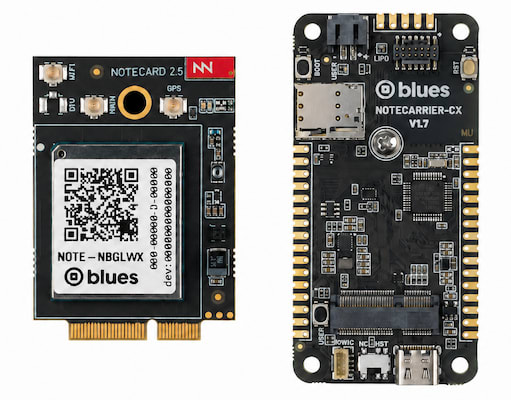
Notecard for Skylo combines global cellular, WiFi, and satellite connectivity in a single Notecard, with no second radio module to mount or route on your board. This kit pairs it with a Notecarrier CX and its onboard STM32L433 host MCU, so you can send your first Note over satellite without wiring up hardware of your own.
noteSatellite data is bundled with the hardware purchase through a partnership with Skylo. The kit includes 10 KB of satellite data with no monthly service fees.
Kit Contents
- Notecard for Skylo
- Notecarrier CX with onboard STM32L433 host MCU
- Dual Cellular and Satellite antenna
- GPS antenna
Starnote for Skylo Starter Kit

Starnote adds fallback satellite connectivity to a Notecard-based design, ideal for deployments that need to keep reporting in areas with limited cellular or WiFi coverage. This kit pairs Starnote with a Notecard WiFi so you can prototype satellite failover end-to-end.
noteSatellite data is bundled with the hardware purchase through a partnership with Skylo. The kit includes 10 KB of satellite data with no monthly service fees.
Kit Contents
- Starnote for Skylo (u.FL version)
- Notecard WiFi
- Notecarrier XS
- Satellite antenna
- GPS antenna
- 500 mAh LiPo battery
Starnote for Iridium Starter Kit

Starnote for Iridium pairs with an existing Notecard to add Iridium's low Earth orbit satellite network, which reaches everywhere on the planet, including open ocean and polar regions that no geostationary network covers. This kit pairs it with a Notecard Cell+WiFi on a Notecarrier XI, so the Notecard handles cellular and WiFi and falls back to satellite on its own.
noteSatellite data is bundled with the hardware purchase. The kit includes 10 KB of Iridium satellite data with no monthly service fees.
 tip
tipNot sure whether Skylo or Iridium fits your deployment? See Choosing Between Skylo and Iridium.
Kit Contents
- Starnote for Iridium
- Notecard Cell+WiFi MBGLW
- Notecarrier XI
- Iridium helical satellite antenna, which handles both satellite and GPS
- 5000 mAh LiPo battery
Blues Starter Kit for LoRaWAN
The Blues Starter Kit for LoRaWAN is the fastest way to start building LoRa and LoRaWAN solutions on Notecard. It includes everything you need to bring up a private LoRaWAN network on The Things Stack: a pre-configured gateway and three Notecard for Lora devices with batteries and antennas.
Notecard for Lora is API-compatible with cellular and WiFi Notecards, so code you write on a cellular- or WiFi-based project ports cleanly to a LoRaWAN deployment.
Kit Contents
- WisGate Edge Lite 2 LoRaWAN gateway
- 3 x Notecard for Lora
- 3 x Notecarrier B
- 3 x 500 mAh LiPo batteries
- 3 x LoRa antennas
The Blues Starter Kit for LoRaWAN is available in US (915 MHz) and Europe (868 MHz) variants.

Deciding on a Cellular Technology
When you're ready to move beyond a starter kit, you may want to optimize your BOM and utilize a more cost-efficient cellular-based Notecard. This section will help you make that choice for your product.
The Notecard Cellular products (Cell+WiFi and Cellular) support Wideband, Midband, or Narrowband technologies, denoted by their SKU. Depending on your use case and/or deployment region, it may be optimal to select a Notecard with the appropriate cellular technology.
Wideband (LTE Cat-1)
Wideband Notecards are ideal for applications that require higher-speed data, in particular for applications that require larger data payloads and/or moving devices (e.g. vehicles).
Pros:
- Higher data rates (up to 10 Mbps downlink, 5 Mbps uplink)
- Good for applications requiring large data transfers such as binary data (e.g. images or audio)
- Lower latency (typically 50-100ms)
- Well-established technology with broad coverage
Cons:
- Requires dual antennas to achieve full coverage
- Higher power consumption than Narrowband
- More expensive modules
Typical Deployment Scenarios:
- Remote diagnostic equipment sending large datasets
- Industrial equipment requiring real-time monitoring
- Fleet management systems with real-time tracking
Midband (LTE Cat-1 bis)
The Midband Notecards are ideal for applications that don't require the full complexity (LTE) of Wideband, but still require higher data rates than Narrowband.
Pros:
- Higher data rates (up to 10 Mbps downlink, 5 Mbps uplink)
- Simplified device design compared to Cat-1
- Improved power efficiency than Cat-1
- Reduced cost compared to Cat-1
- Only requires a single antenna to achieve full coverage
Cons:
- Consumes more power than Narrowband options
Typical Deployment Scenarios:
- Smart metering with frequent and moderate data transmission
- Building automation systems
- Asset tracking with regular updates
Narrowband (LTE-M & NB-IoT)
The Narrowband Notecards are ideal for applications that require the lowest power consumption and are typically stationary.
Pros:
- Moderate data rates (up to 1 Mbps)
- Lowest power consumption
- Better indoor penetration than Cat-1
Cons:
- Lower throughput than Cat-1/Cat-1 bis
- Higher latency than Wideband or Midband
- Less available coverage in some regions
- Poor performance for moving devices
Typical Deployment Scenarios:
- Smart utility meters in fixed locations
- Environmental sensors in remote areas
- Parking sensors and smart waste bins
noteTypically, LTE Cat-1 and LTE Cat-1 bis are more widely available than LTE-M and NB-IoT. To aid in forecasting Notecard's compatibility with a specific country, check the country coverage for the specific Notecard SKU you are using.
